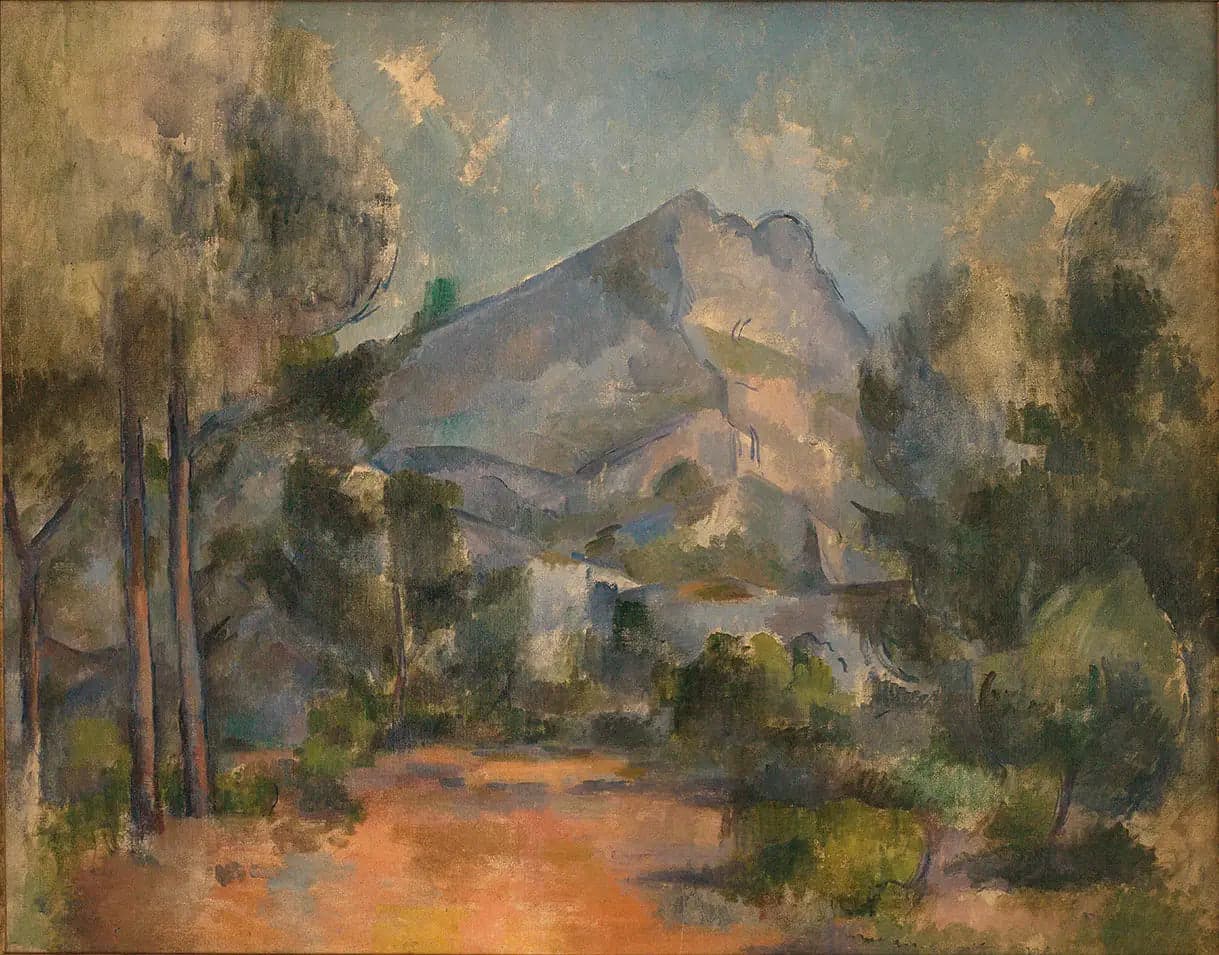
The Montagne Sainte-Victoire
- Original dimensions
- 65.4 x 55 cm
- Museum
- National Galleries of Scotland
- Year
- 1890
Scene depicted
In this canvas , Cézanne captures the very essence of Provence. The painting reveals to us the imposing silhouette of the Montagne Sainte-Victoire, sometimes haloed in light, sometimes darkened by clouds. Each brushstroke comes together to form a rich and textured composition, embodying the dialogue between earth and sky. The shades of green and blue in the sky evoke not only natural beauty but also a deep sense of peace.
Historical context
Created in 1890, the masterful painting by Paul Cézanne , titled La Montagne Sainte-Victoire , is located in the heart of Provence, in Aix-en-Provence, where the artist long drew his inspiration. Part of the post-impressionist movement, this canvas is now revealed within the National Galleries of Scotland , while being a centerpiece of the transition to modern art. This work of 65.4 x 55 cm embodies an era where light and color become the universal language of emotion.
Place in the artist's career
La Montagne Sainte-Victoire represents a significant turning point in the career of Paul Cézanne . After works such as The Card Players and The Hanging House , this painting testifies to his growing mastery in capturing light and landscape. Cézanne is here at the peak of his creativity, blending technique and emotion, while moving towards a bolder visual vocabulary that will influence generations of artists.
Anecdote
Paul Cézanne once stated: "I want to spend as much time as possible contemplating nature to better reproduce it." This phrase resonates strongly when discussing the genesis of his masterpiece . Imagine Cézanne, one April morning, sitting in front of the majestic Montagne Sainte-Victoire, cradled by the song of birds and the scent of eucalyptus. The embrace of nature whispers secrets to him that only his colors can translate, transforming the scene into a painting vibrant with emotions.