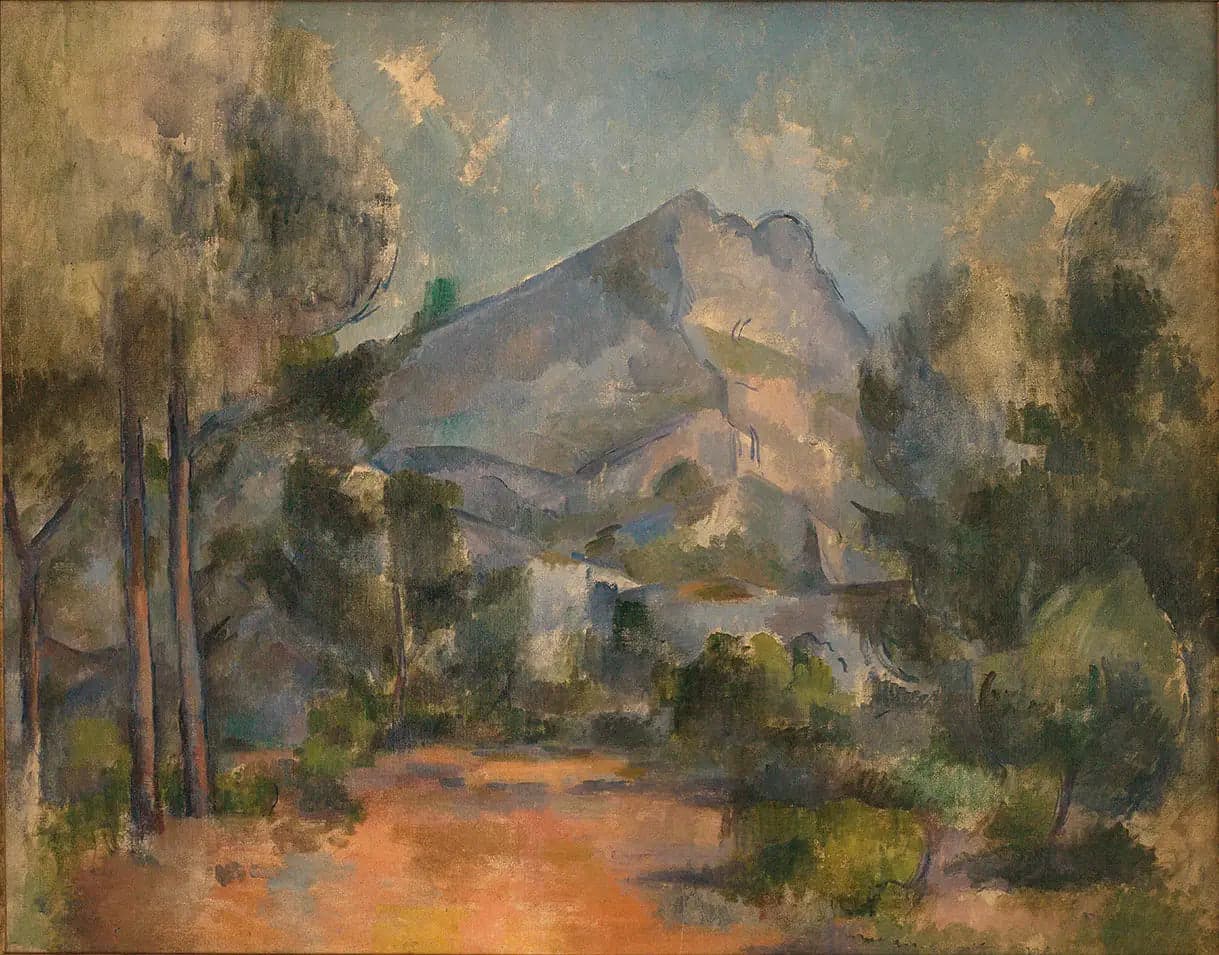
The Montagne Sainte-Victoire
- Original dimensions
- 81 x 65 cm
- Museum
- Seattle
- Year
- 1889
Scene depicted
In this painting, the majesty of Sainte-Victoire emerges, standing proudly under a sky crossed by silver clouds. The composition, marked by geometric shapes and a bold palette, testifies to Cézanne's love for this landscape that he painted many times. Every element, from the surrounding greenery to the rocks, breathes the very essence of Provence, thus evoking a strong connection to the land that the artist cherished.
Historical context
Created in 1889, in Aix-en-Provence, this canvas is emblematic of the post-impressionist movement, revealing the beginnings of a new pictorial vision. At that time, Paul Cézanne focused on these familiar landscapes that inspired him so much, offering a vibrant testimony of his environment. Today, this painting resides in the Seattle museum, where visitors can admire its impressive dimensions.
Place in the artist's career
La Montagne Sainte-Victoire represents a pivot in Cézanne's career, embodying his mature style. In parallel, works such as Les Joueurs de cartes and Les Grandes Baigneuses show the technical evolution of his approach, each painting becoming a chapter in a rich artistic story, marked by an unceasing quest for the simplification of forms and the depth of colors.
Anecdote
“The mountain is my friend!” declared Cézanne during his morning walks. Inspired by the calm of a sunny spring, he captured fragments of light on the landscape, infusing the strength of nature into every brushstroke of this masterpiece . This embodied approach resonates in La Montagne Sainte-Victoire , where the details become poetry.
Major exhibitions
Seeing Nature: Landscape Masterworks from the Paul G. Allen Family Collection