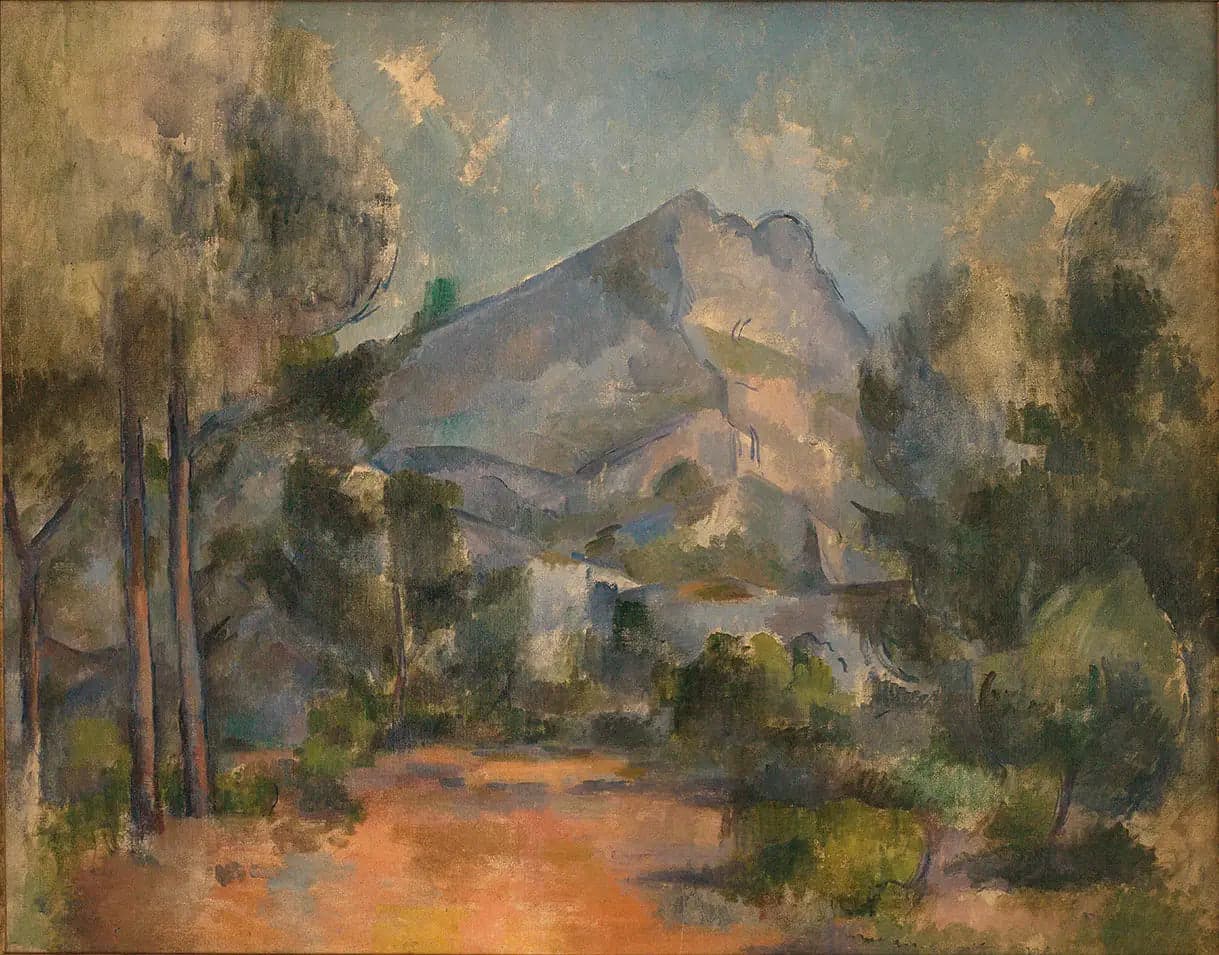
The Montagne Sainte-Victoire
- Original dimensions
- 91.5 x 73 cm
- Museum
- Not specified
- Year
- 1897
Scene depicted
In La Montagne Sainte-Victoire , Cézanne immortalizes the imposing silhouette of the mountain that dominates the landscape. He uses geometric brushstrokes to form this harmonious structure, creating a dialogue between the earth and the sky. The variations of light and colors evoke the passage of the seasons, making this scene an eternal invitation to contemplation.
Historical context
Created in 1897, this painting was born in the region of Aix-en-Provence, an iconic city in the south of France. La Montagne Sainte-Victoire is at the heart of the post-impressionist movement. At a time when art seeks to represent nature with sincere emotions, this pictorial work stands out for its boldness. Although it is not exhibited in a well-known museum, its impact and popularity have continued to evolve over time and exhibitions.
Place in the artist's career
La Montagne Sainte-Victoire represents a turning point in Cézanne's career, a culmination of his reflections on form and color. Alongside other magnificent compositions such as Les Joueurs de cartes and La Maison de l’artiste , this painting highlights his process of experimentation, testifying to the evolution of his style towards greater abstraction.
Anecdote
Paul Cézanne once stated: "I am the dreamer of my own reality." This painting reflects this inner quest, capturing the first rays of a spring morning, where light pierces the clouds, revealing the grandeur of the Provençal landscapes. This transcendent moment, shared with nature, is etched in every brushstroke of this masterpiece .