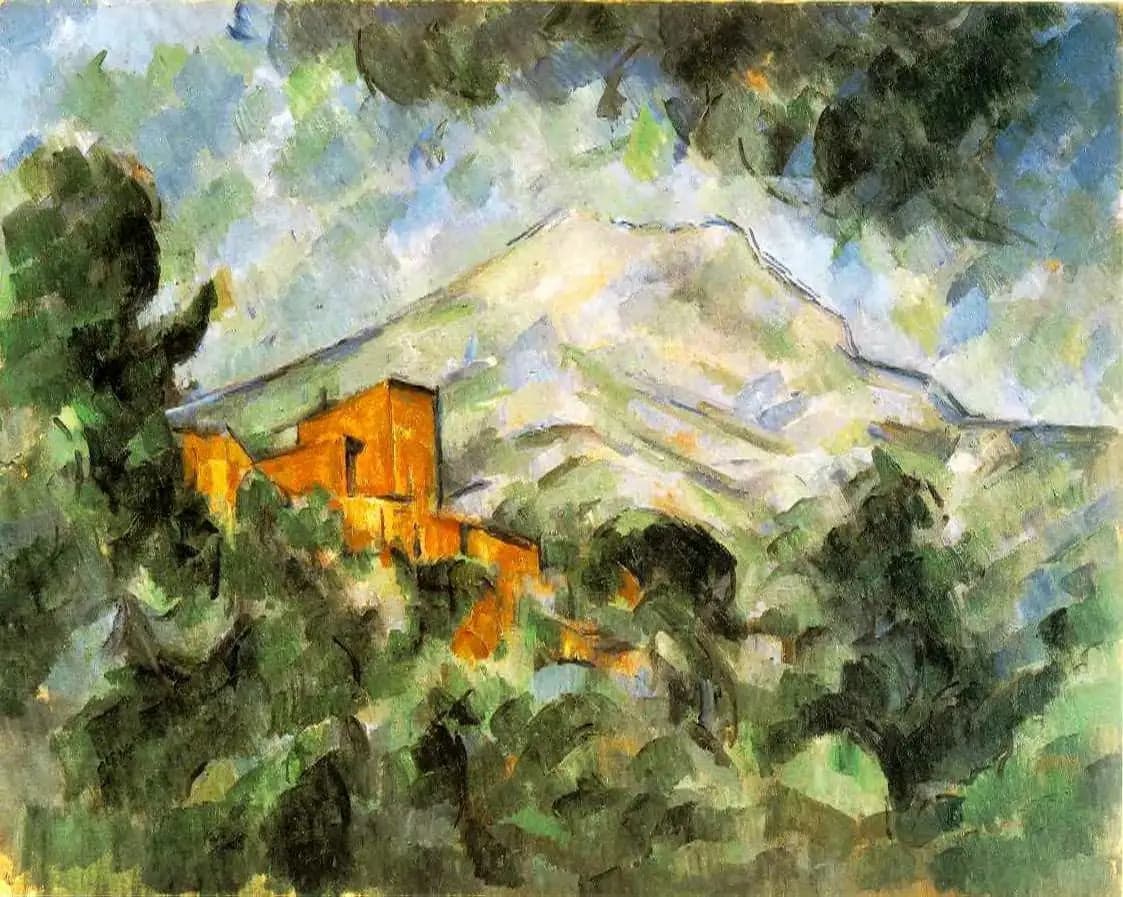
The Montagne Sainte-Victoire and Château Noir
- Original dimensions
- 81 x 65.6 cm
- Museum
- Artizon Museum
- Year
- 1904
Scene depicted
In this composition , Cézanne transports us to the heart of a breathtaking landscape, where the majesty of La Montagne Sainte-Victoire stands tall and imposing. At its feet, the Château Noir, with its mysterious silhouettes, blends into a backdrop of lush greenery. This canvas sublime is not just a simple painting, but a celebration of the harmony between man and nature, where each element vibrates to the rhythm of the Provençal landscape. The shades of earth and sky intertwine, creating an atmosphere of tranquility and emotional resonance.
Historical context
Created in 1904, this painting resides in the picturesque setting of Aix-en-Provence, in the heart of Provence, an iconic region that saw the birth of the great artist Paul Cézanne . This work is part of the post-impressionist movement, where the artist, through his bold brushstrokes, captures light and forms with a unique sensitivity. Currently exhibited at the Artizon Museum , this canvas responds to a quest for beauty and geometry characteristic of this master of painting. Its generous dimension of 81 x 65.6 cm attracts the eye and invites contemplation.
Place in the artist's career
This canvas positions itself as a milestone in Cézanne's artistic evolution, testifying to his period of maturity. Alongside other bubbling masterpieces such as The Card Players and The House of the Pine Grove , the painting embodies a refined stylistic search. Cézanne, experimenting with light and forms, proposes a visual language that is his own, marking a crucial turning point in the history of art.
Anecdote
“I would like to paint nature as it is, purified of everything that uglifies it,” Cézanne is said to have remarked one morning while contemplating the hills of his homeland. This phrase resonates as an echo of the many hours spent capturing the very essence of nature, from its mountains to the sky. In his creation of La Montagne Sainte-Victoire et Château Noir , one feels this quest for authenticity that transcends mere execution. The work, both vibrant and peaceful, is the fruit of this intact inspiration, immortalized by gestures imbued with passion.