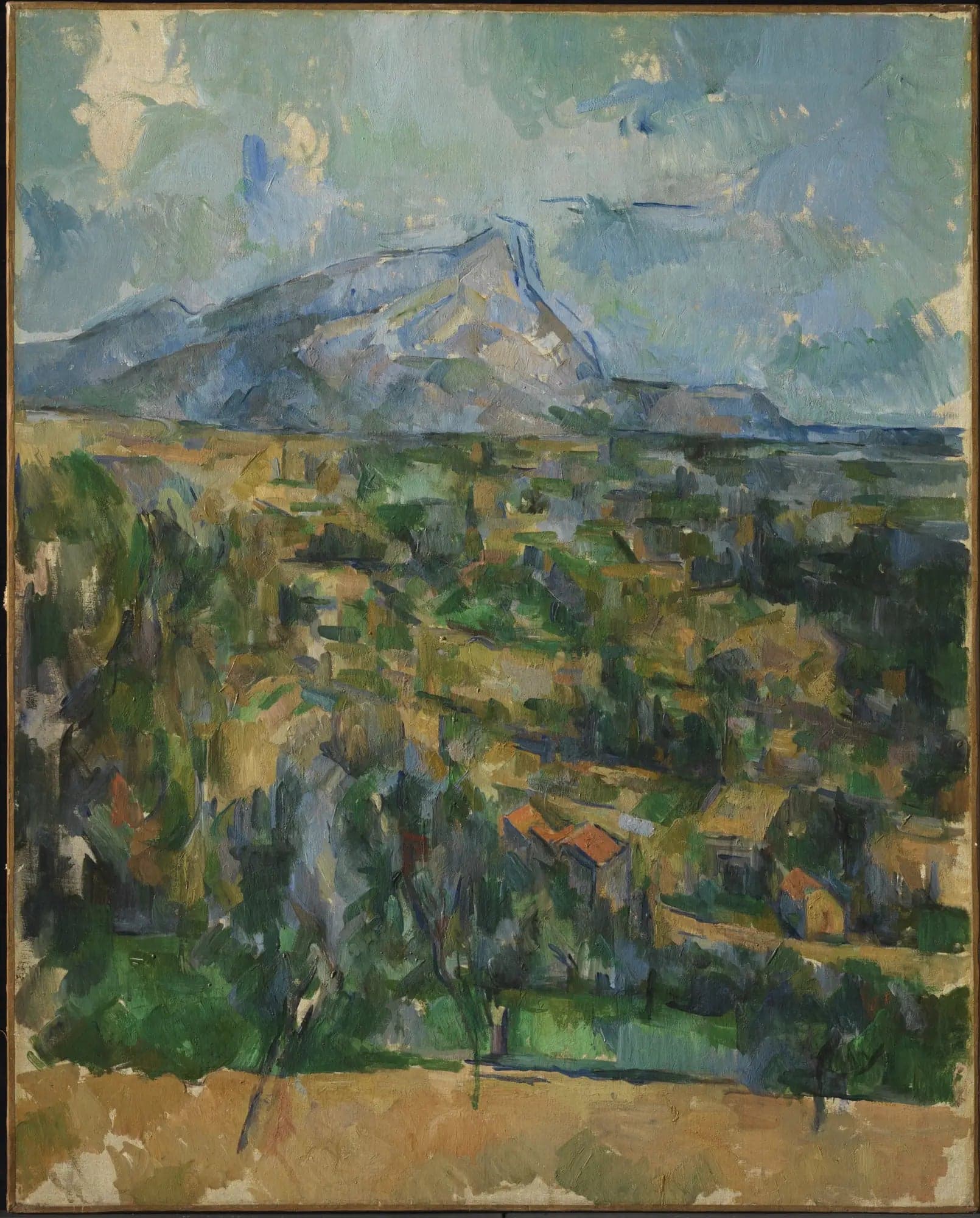
The Mont Sainte-Victoire seen from Les Lauves
- Original dimensions
- 72.2 x 59.9 cm
- Museum
- Kunstmuseum Basel
- Year
- 1904
Scene depicted
In this painting, the Mountain Sainte-Victoire rises majestically, surrounded by lush landscapes, bathed in golden light. The geometric shapes, characteristic of Cézanne's style, blend in a fascinating harmony. The gaze is quickly sublimated by the meeting of shadow and light, transporting the viewer deep into the heart of Provence.
Historical context
Delicately crafted, The Mountain Sainte-Victoire seen from Lauves is an oil painting emblematic of Paul Cézanne created in 1904, a pillar of the Impressionist movement. Evoking the deep identity of Provence, it finds refuge at the Kunstmuseum in Basel, Switzerland. This canvas measures 72.2 x 59.9 cm, encapsulating the soul of an era where art begins to live freely, away from academic constraints.
Place in the artist's career
The Mountain Sainte-Victoire seen from Lauves marks a turning point in Cézanne's career. Touching on the maturity of his style, this work dialogues with other emblematic pieces such as the 1895 painting, The Large Bathers, and The Artist's Garden, reflecting the evolution of his technique. Each painting approaches nature through the prism of abstraction, with an increasingly bold emotional palette.
Anecdote
Paul Cézanne once declared: “I want to make a painting that is the equivalent of a great landscape.” It is in the morning light, overlooking the Provençal hills, that he drew inspiration to create this masterpiece . A space of tranquility, a suspended moment, transcribed in this canvas vibrant with emotions.