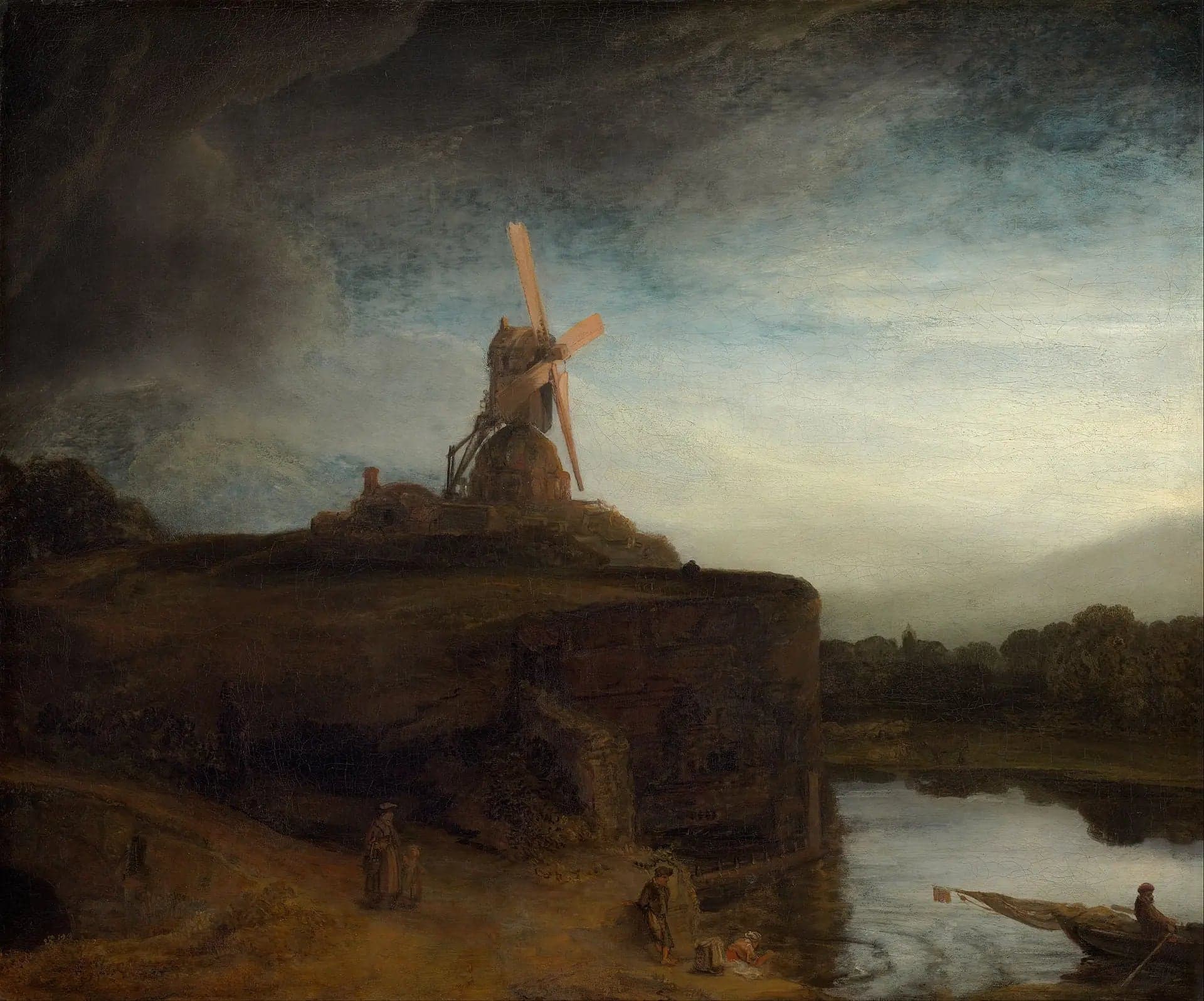
The Mill
- Original dimensions
- 105.6 x 87.6 cm
- Movement
- Dutch Golden Age
- Museum
- National Gallery of Art
- Year
- 1648
Scene depicted
The painting “The Mill” immerses us in a serene landscape where the mill, majestic and robust, stands silhouetted against a vibrant sky, evoking both tranquility and the power of nature. With its delicate details and soothing atmosphere, this painting transports us to the heart of a rural era, where the mill symbolizes not only an element of the landscape but also an essential link between man and his environment, capturing the essence of daily life.
Historical context
Created in 1648, in the historic city of Amsterdam, this iconic painting is set against the vibrant backdrop of the Dutch Golden Age of painting. At that time, artists merged technical virtuosity with meticulous attention to detail to capture the rich daily life, transforming ordinary scenes into true masterpieces. The canvas, now housed in the National Gallery of Art , testifies to the artistic excellence of its creator and the exquisite dimensions that inhabit it.
Place in the artist's career
“The Mill” represents a pivotal moment in the career of Rembrandt , where his technical mastery reaches a peak. Alongside "The Night Watch" and "The Return of the Prodigal Son," this painting reveals his stylistic evolution, oscillating between light and shadow, realism and poetry. Thus, “The Mill” stands as a point of maturation, testifying to the complex soul of an artist in the relentless pursuit of truth in art.
Anecdote
In a moment of typical dawn softness, Rembrandt reportedly said: “Every light has its shadow, and that is where the emotion lies.” Inspired by a charming view of a mill that uniquely captures light, this anecdote reveals the common thread of his art. Every brushstroke, every nuance of color on the canvas The Mill tells a story of depth and tension, awakening in us an echo of ancient lives.