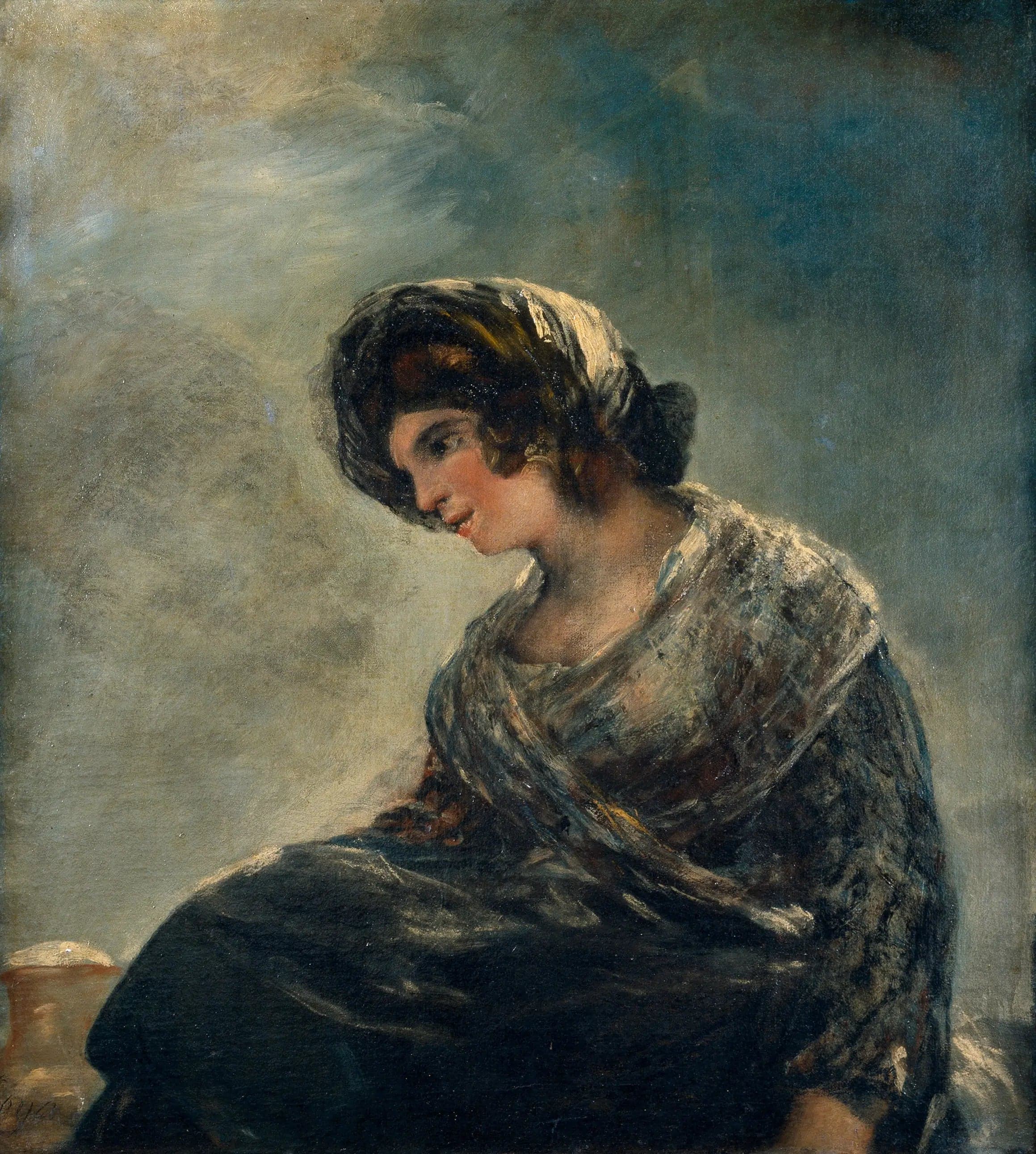
The Milkmaid of Bordeaux
- Original dimensions
- 68 x 74 cm
- Movement
- Neoclassicism
- Museum
- Prado Museum
- Year
- 1827
Scene depicted
This masterpiece by Goya features a woman gracefully immersing herself in the art of milk-making, integrating daily gestures into a harmonious composition. She is surrounded by delicate colors and meticulous details that evoke an atmosphere of serenity and contemplation. Goya excels here in capturing the moment, immortalizing the everyday with vibrant poetry.
Historical context
It is in the heart of early 19th century Spain, in the intellectual climate of neoclassicism, that Francisco de Goya created this iconic painting in 1827. This canvas is now displayed at the prestigious Prado Museum in Madrid, where its beauty and depth continue to enchant visitors. With dimensions of 68 x 74 cm, this canvas evokes a time rich in artistic and social changes.
Place in the artist's career
The Milkmaid of Bordeaux is part of a crucial period in Goya's career, marking a stylistic turning point towards a more intimate and human approach, contrasting with his earlier works inspired by a raw realism . Alongside other paintings such as The Naked Maja and The Third of May 1808, this painting reflects the evolution of an artist in search of emotional truth and light.
Anecdote
“I paint the light of fleeting moments, capturing the ephemeral essence of life.” Thus spoke Goya, inspired by a fresh spring morning in a quiet alley of Bordeaux. It is in this intoxicating setting that he allowed himself to be guided by the soothing sounds of the alleys, the scent of budding flowers, and the softness of light filtering through the leaves, bringing The Milkmaid of Bordeaux to life.