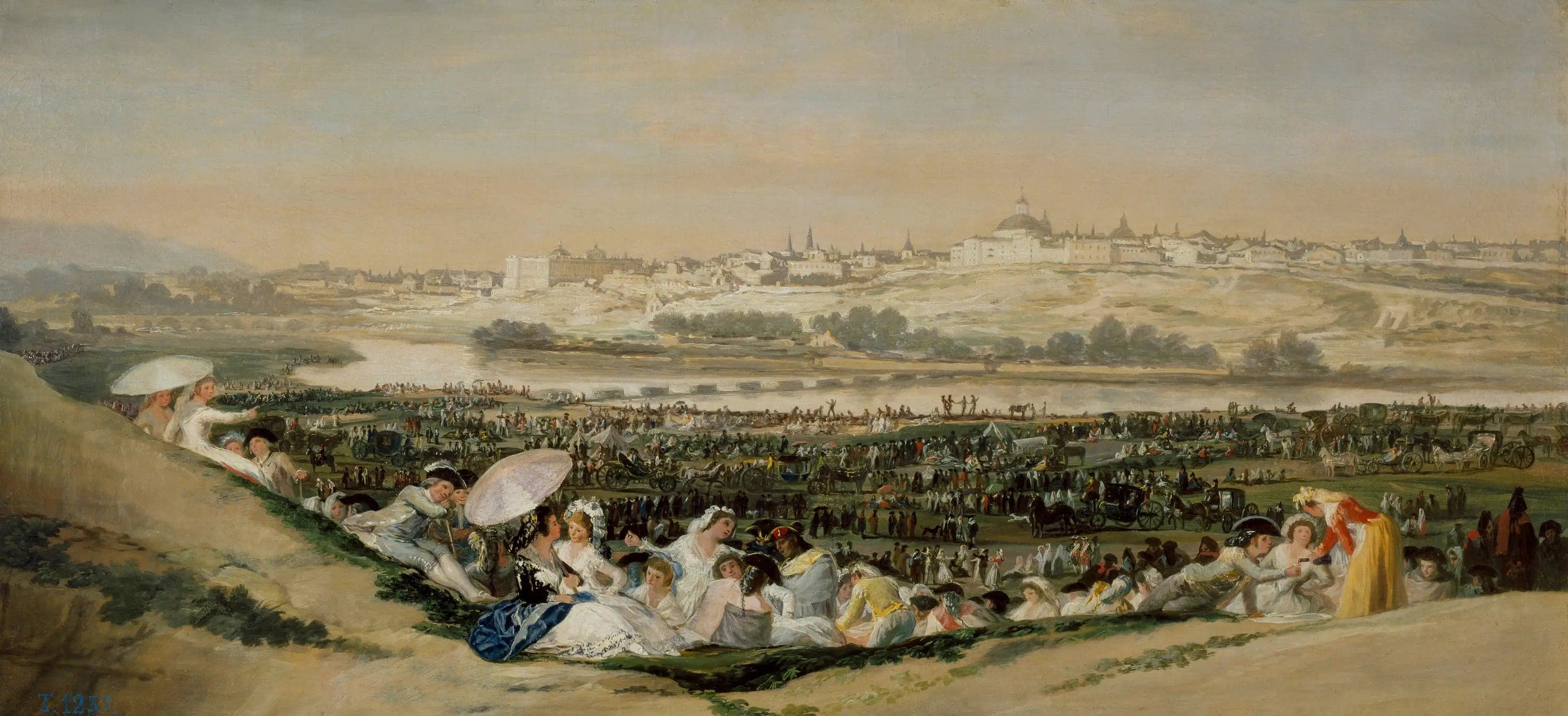
The Meadow of Saint Isidore
- Original dimensions
- 90.8 x 41.9 cm
- Museum
- Prado Museum
- Year
- 1788
Scene depicted
“The Meadow of Saint Isidore” depicts an idyllic tableau, where greenery envelops rural life. Lush fields stretch as far as the eye can see, bathed in the softness of morning light. Goya, a virtuoso of light, makes every detail of this work shine, allowing the viewer to experience a moment of tranquility within a vibrant atmosphere.
Historical context
Created in Madrid, in the heart of Spain, at the end of the 18th century, the painting "The Meadow of Saint Isidore" is part of the artistic movement of Romanticism . During this period of cultural transformation, Goya merges tradition and modernity, offering a unique glimpse into the Spanish soul. This canvas , now housed in the Prado Museum, fascinates with its impressive dimensions of 90.8 x 41.9 cm.
Place in the artist's career
This painting represents a pivotal moment in Goya's artistic journey, oscillating between a marked classicist influence and later more introspective works. Positioned between his early creations and emotionally charged narratives, such as “The Executions of May 3, 1808,” “The Meadow of Saint Isidore” testifies to an evolution towards a more freely artistic expression.
Anecdote
“When nature awakens, it whispers stories that only the heart can understand.” In this quote, one perceives the essence of Goya's inspiration. Imagine him one spring morning, lost in the harmonies of a flourishing landscape, a scene vibrating with intimacy and melancholy, translating into a timeless evocation in this painting .