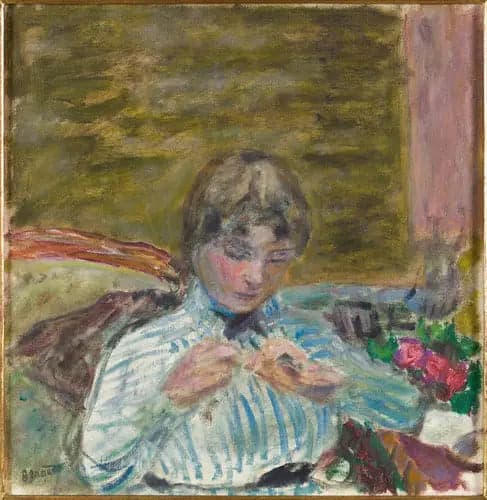
The Manicure
- Original dimensions
- 35.4 x 36.2 cm
- Museum
- Orsay Museum
- Year
- 1912
Scene depicted
In “The Manicure,” Bonnard offers us a scene that seems to capture a moment of tenderness and respite. The characters, immersed in the intimacy of a hand care, reveal the beauty of the ordinary, magnified by the artist's art. The atmosphere is soothing and imbued with a warm softness, making each gesture poetic and rich in meaning.
Historical context
Created in 1912, this painting is set in the heart of Paris, the capital of the arts, at a time when the Nabi movement, of which Pierre Bonnard was one of the spearheads, was flourishing. At the crossroads of Impressionist and Post-Impressionist influences, the canvas is currently exhibited at the prestigious Orsay Museum , a sanctuary for art lovers that illustrates the great richness of this era. Its dimensions, modest yet impactful, add to its unique presence.
Place in the artist's career
“The Manicure” marks a significant milestone in Bonnard's career, who finds himself at a creative turning point, combining his sensitivity to color with the exploration of themes of everyday life. Like other paintings such as “The Two Sisters” and “Luncheon on the Grass,” this painting reflects the evolution of his style, oscillating between intimacy and expressionism, while revealing his mastery of forms and spaces.
Anecdote
“I wanted to capture a fleeting moment, a burst of light in the mundane,” Bonnard might have said, reflecting on his artistic quest. On a gentle Parisian morning, while wandering through the alleys in search of inspiration, he encountered luminous, ephemeral faces that reminded him of the intimacy of everyday gestures. It is from this simple magic that “The Manicure” was born, a painting vibrant with emotions.