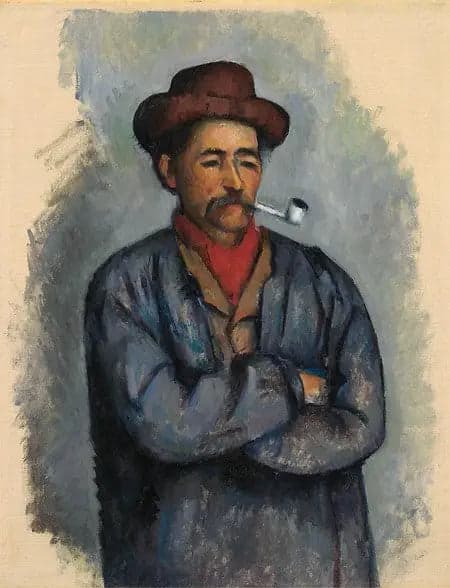
The Man with the Pipe
- Original dimensions
- 30.2 x 39 cm
- Museum
- Nelson-Atkins Museum of Art
- Year
- 1891
Scene depicted
In this painting, the blurred background seems to envelop a serene protagonist, lost in his thoughts. The man, pipe in hand, embodies a refined simplicity, posing a silent question about human nature and its reflections. Cézanne manages to capture this fleeting moment with a peaceful atmosphere, vibrating the instant of an ordinary life with captivating psychological depth.
Historical context
Created in 1891, this canvas titled The Man with the Pipe flourishes in the peaceful setting of Aix-en-Provence, in the heart of Provence, which was then in full artistic effervescence. Paul Cézanne , an iconic figure of post-impressionism , invites us to admire his subtle play of form and color. Currently exhibited at the Nelson-Atkins Museum of Art , this work remains an authentic testimony of a time when art sought to emancipate itself from conventions.
Place in the artist's career
The Man with the Pipe fits perfectly into Cézanne's artistic maturity, as he distances himself from impressionist principles to explore structure and color. Alongside his masterpieces like The Card Players and Mont Sainte-Victoire, this painting testifies to the evolution of his technique, towards a subtle quest for balance between form and content.
Anecdote
“Art is a path to emotion,” said Cézanne, on a sunny morning, in his studio, surrounded by the scents of fresh paint and varnish. It is in this inspiring setting that he imagined this masterpiece , crossing the gaze of a man, his lost expression, his pipe testifying to a deep introspection that still resonates in our quest for meaning.