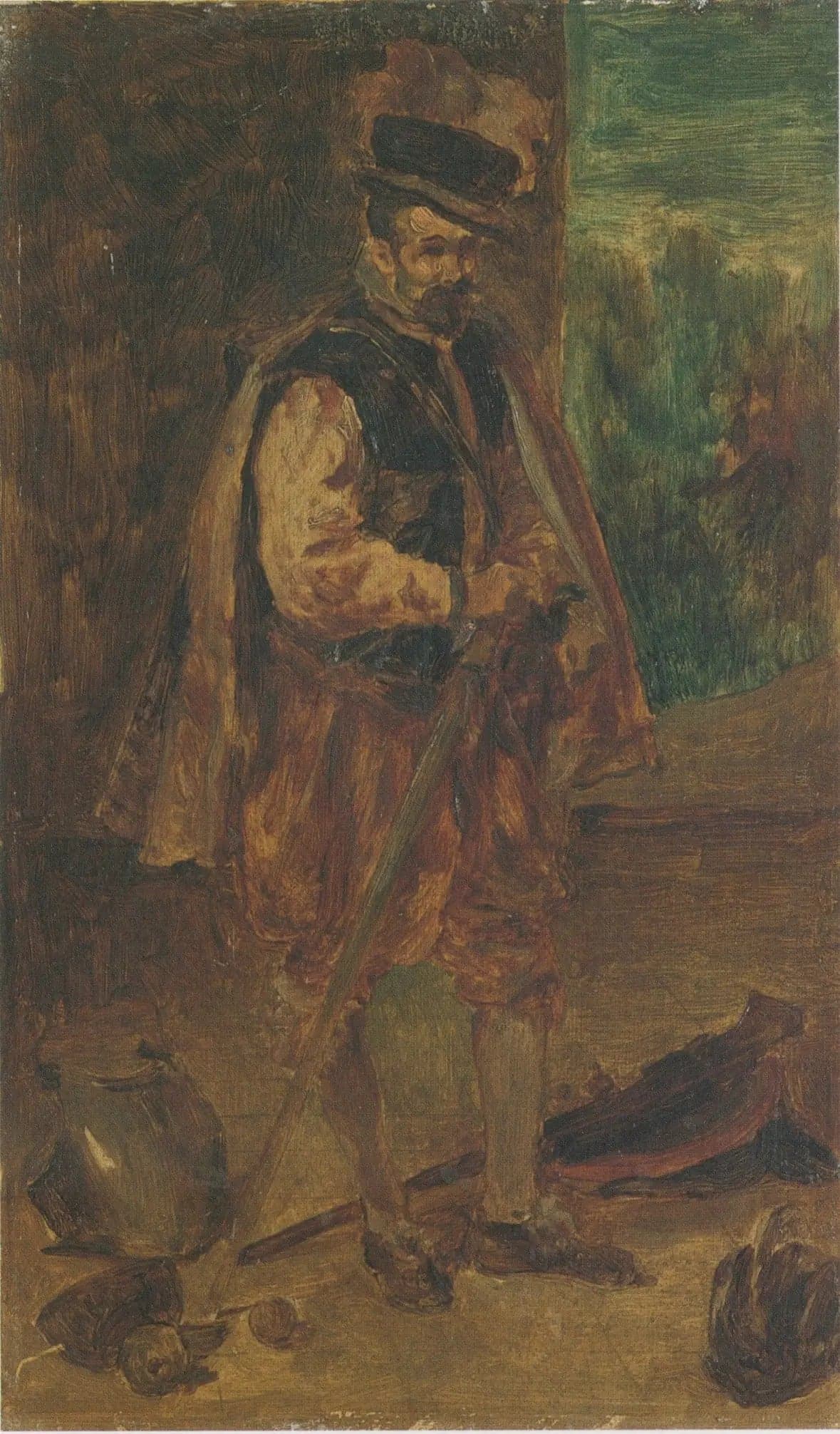
The Man with a Cane
- Original dimensions
- 19 x 31.8 cm
- Museum
- Menard Art Museum
- Year
- 1865
Scene depicted
The canvas features an older man, whose expression and posture tell a story of experience, solitude, and elegance. The cane, a symbol of dignity, evokes both physical support and a certain wisdom acquired over time. Manet succeeds in capturing not only the appearance but also the soul of his model in this vibrant pictorial work .
Historical context
Created in 1865, in Paris, this painting is emblematic of the Impressionist movement, a period of artistic friction where Innovation disrupts conventions. The work, which is now in the Menard Art Museum, reflects a period of aesthetic transition. This canvas of modest dimensions, 19 x 31.8 cm, evokes an intimacy that only canvases from this era can convey.
Place in the artist's career
With Man with a Cane , Manet enters a significant phase of his career, marked by artistic maturity and an exploration of character psychology. This painting echoes his masterpiece “Olympia” and the poignant “Luncheon on the Grass,” two masterworks that surround this essential moment of his evolution, where he begins to adapt his style to modern life.
Anecdote
“Art must capture the moment, nourished by the eye, carried by the heart.” Édouard Manet reportedly said this one spring morning as he observed a man with a cane wandering along the banks of the Seine. This fleeting moment, full of lightness and mystery, inspired the painting that is Man with a Cane , a true representation of a humanity often overlooked.