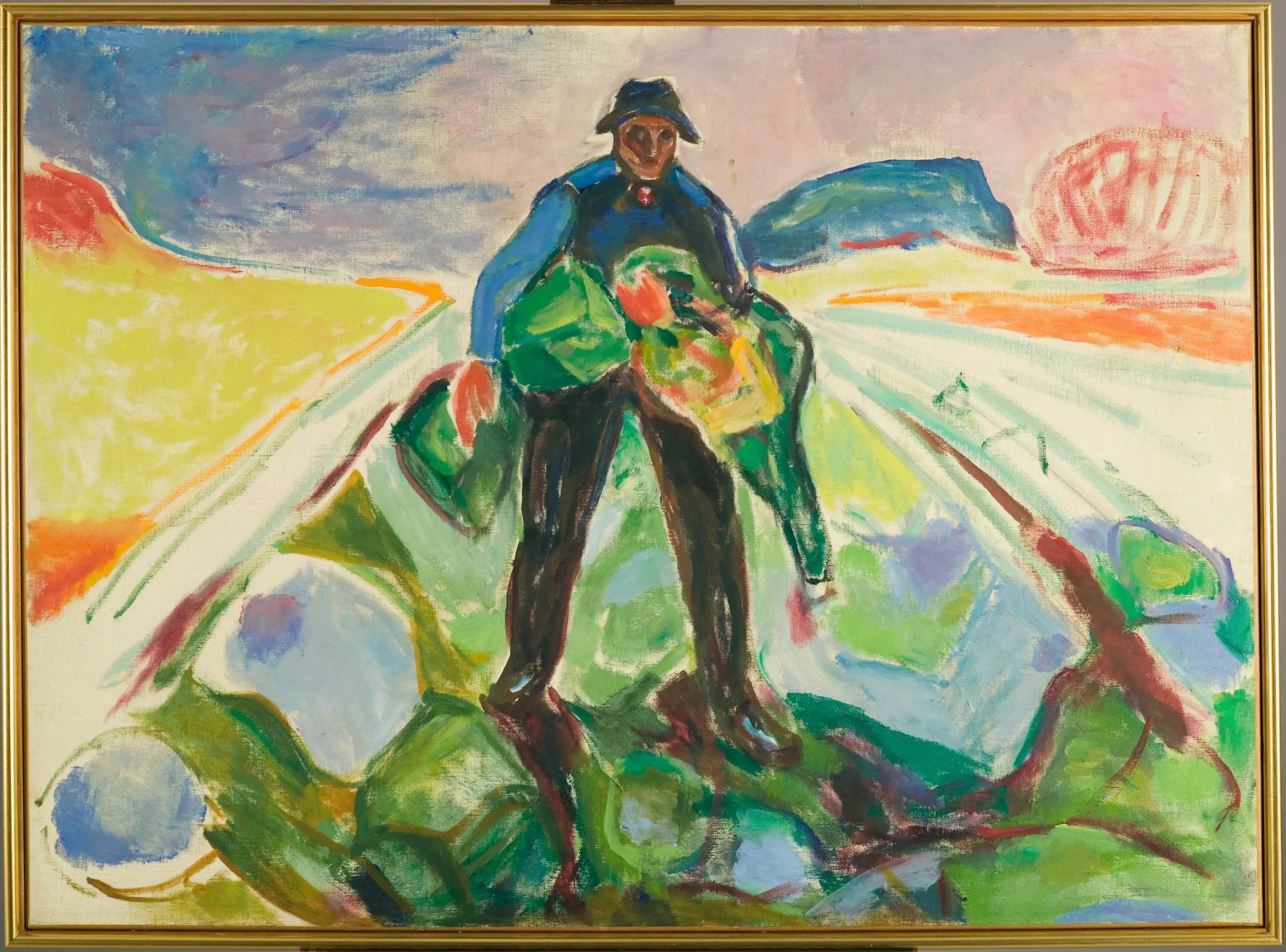
The Man in the Cabbage Field
- Original dimensions
- 150.5 x 110.5 cm
- Museum
- Munch Museum
- Year
- 1943
Scene depicted
This painting offers a poetic representation of a man, lost in his thoughts, delicately wandering among the cabbage plants. Each brushstroke reveals the harmony and beauty of this simple agricultural scene, while hinting at the tumultuous emotions of the artist. Munch invites us to feel the depth of this connection between human beings and nature, an exploration of isolation and belonging to the earth that unfolds like a silent melody on the canvas.
Historical context
Created in the heart of Oslo, Norway, in 1943, The Man in the Cabbage Field is an iconic work of the expressionist movement. This painting , heavily marked by the turmoil of World War II, immerses us in the intimacy of feelings, at a time when Munch, immersed in his creative universe, draws inspiration from simple landscapes and everyday scenes tinged with emotional intensity.
Place in the artist's career
The Man in the Cabbage Field stands as one of the most significant works of Munch's whispering period. As he reaches stylistic maturity, this painting is alongside works such as The Scream and The Madonna , each illustrating his technical and emotional evolution. In this phase, Munch transcends the boundaries of impressionism to delve into an exploration of colors and forms that speak directly to the soul.
Anecdote
“Nature, in its simplicity, has always touched my heart.” These words of Edvard Munch resonate strongly when observing his masterpiece . Inspired by a morning walk, he captures a moment of tranquility, a suspended instant where the beauty of the cabbage field finds an echo in the breath of the wind. The soft light of day mingles with the scents of the damp earth, and this canvas becomes a reflection of a regained inner peace.
Major exhibitions
Munch og Ekely: 1916-1944