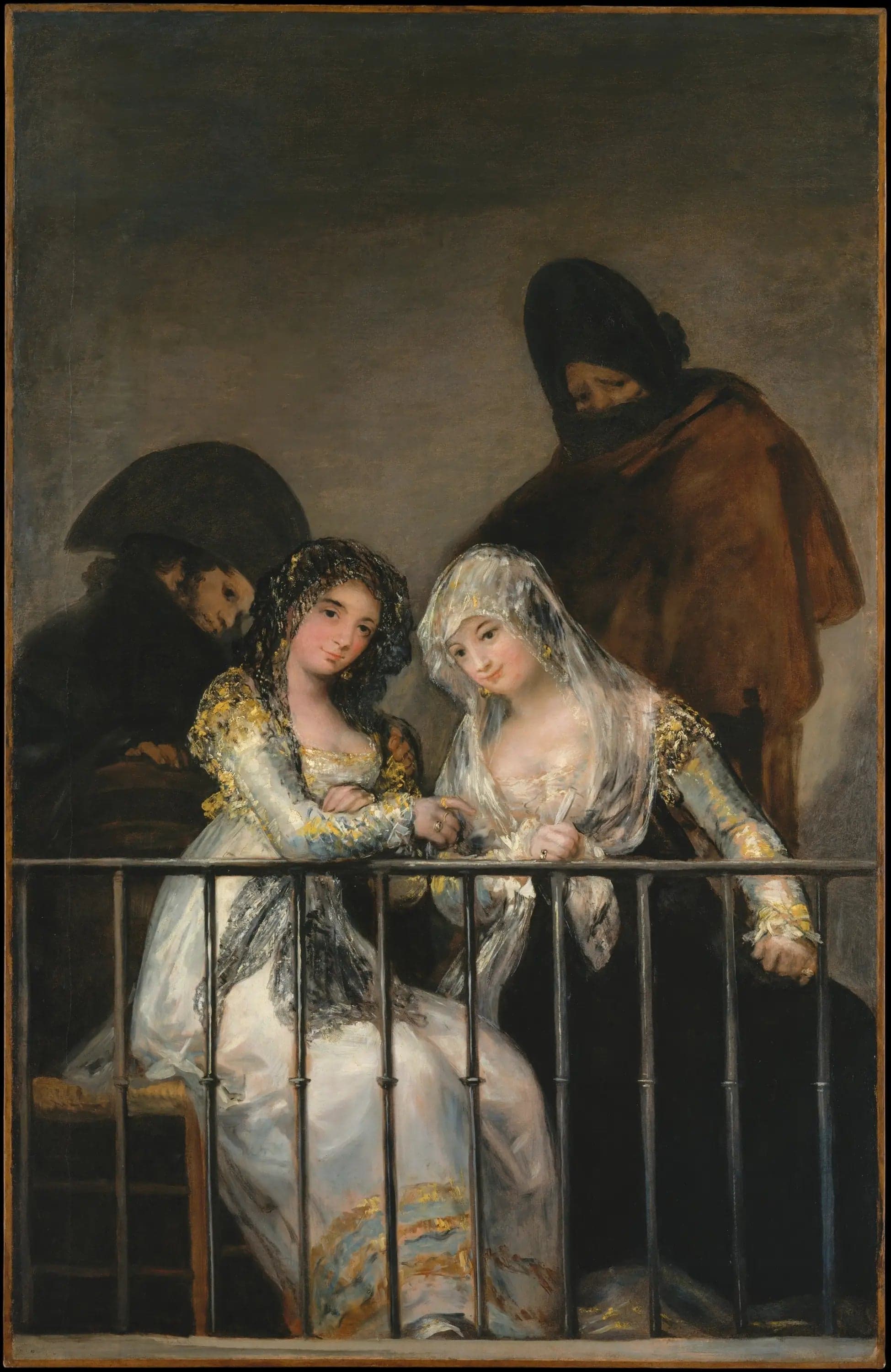
The Maja on the Balcony
- Original dimensions
- 107 x 162 cm
- Museum
- Switzerland
- Year
- 1850
Scene depicted
The painting, the Majas on the Balcony, illustrates two elegantly draped female figures, observing the landscape that stretches before them. Beyond a mere gaze, it is a suspended moment, where viewers can soak in the unfolding instant. The canvas does not limit itself to representing the external beauty of the characters, but also pays tribute to a subtle sensuality and the richness of Spanish identity, thus reinforcing the link between art and culture.
Historical context
This iconic work was created in 1850, at a time when Spain was undergoing profound political and social upheaval. Francisco de Goya , one of the pioneers of the Romantic movement, managed to capture the essence of his time through this masterful painting. Currently exhibited in Switzerland, this fascinating painting immerses us in a world where beauty and despair coexist, while revealing the precise dimensions of this vibrant canvas.
Place in the artist's career
The Majas on the Balcony represents a pivotal period in Goya's career, marking his transition to a more intimate and emotional approach to painting. Alongside works such as La Maja Desnuda and The 3rd of May 1808, this painting illustrates how the artist managed to blend traditional techniques with bold innovations, thus forging his artistic identity.
Anecdote
Goya once stated: “Painting is the voice of the soul.” This virtual sentiment came to life as he stood on the balconies of Madrid, listening to the whispers of lovers and feeling the warmth of spring. It is this emotionally charged atmosphere that allowed him to create his masterpiece, the Majas on the Balcony, a pictorial work full of passion and sensitivity.