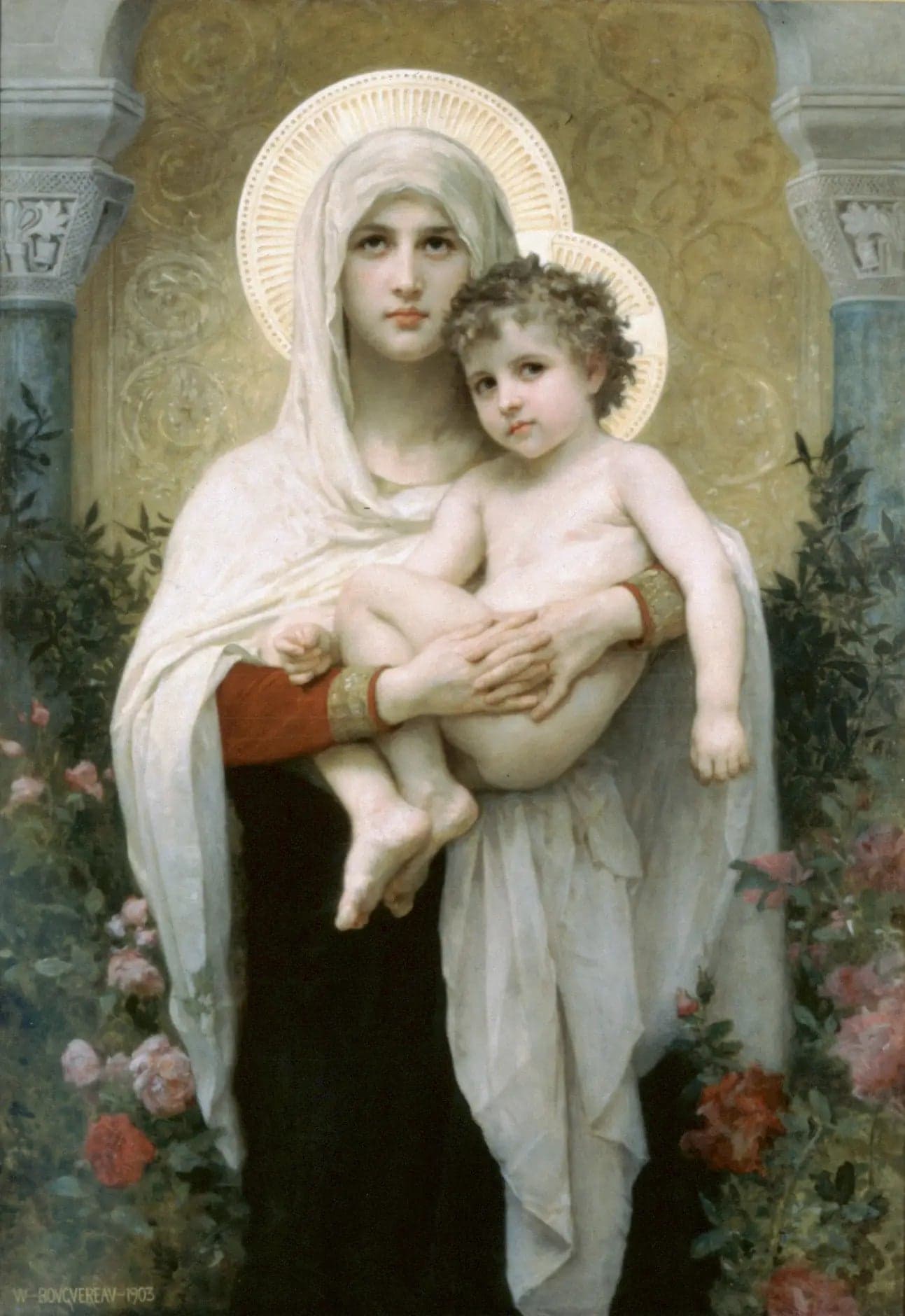
The Madonna with Roses
- Original dimensions
- 89 x 132 cm
- Museum
- Lyndhurst
- Year
- 1903
Scene depicted
This canvas presents a mother revealing her sweetness, her gaze filled with tenderness resting on her child whom she holds tenderly in her arms. The roses, symbols of beauty and love, surround this scene with a delicate atmosphere. Bouguereau, with his mastery of details, creates a link between motherhood and nature, thus uniting two forms of beauty in a single composition.
Historical context
Created in 1903, The Madonna with Roses is set against a backdrop of a time rich in romanticism and realism , in Lyndhurst. This captivating painting is one of the most emblematic works of William-Adolphe Bouguereau , the undisputed master of French academic painting. Currently, this precious canvas is housed in the Lyndhurst museum, where visitors can admire its grandeur, with impressive dimensions of 89 x 132 cm.
Place in the artist's career
The Madonna with Roses represents the pinnacle of Bouguereau's career, illustrating his talent for creating poignant representations of life and love. Compared to other masterpieces such as The Young Girl with the Rose and The Virgin and Child, this canvas demonstrates the artist's stylistic evolution, incorporating advanced techniques of light and texture pushed to their peak.
Anecdote
William-Adolphe Bouguereau often said: “Art must be a means of conveying pure emotions.” One spring morning, while walking through the blooming gardens of his home in Bordeaux, the vision of a young mother surrounded by roses ignited his soul. It was this inspiration that brought The Madonna with Roses to life, a pictorial work that evokes tenderness and timeless beauty.
Major exhibitions
Bouguereau & America