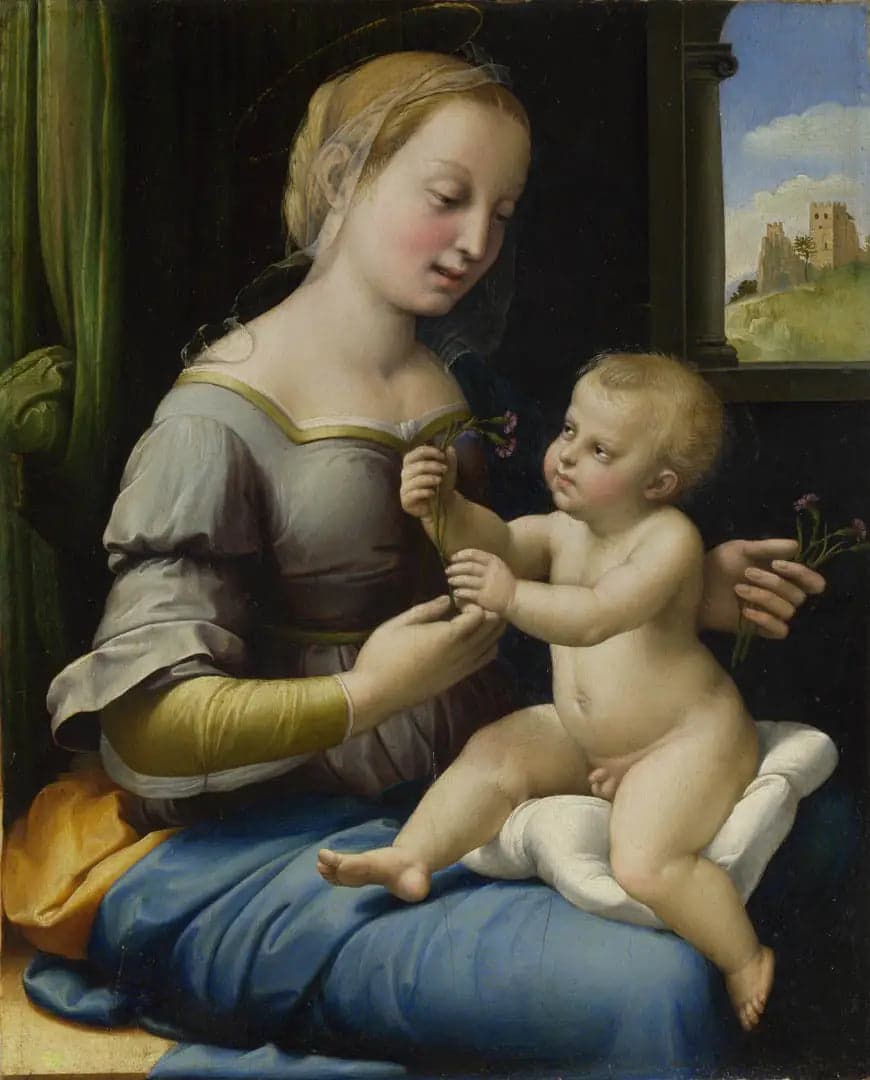
The Madonna of Carnations
- Original dimensions
- 22.4 x 27.9 cm
- Movement
- High Renaissance
- Museum
- National Gallery
- Year
- 1506
Scene depicted
The composition of this canvas represents the Virgin Mary, delicately surrounded by cherubs, offering a serene and gentle vision. The carnations, symbols of love and beauty, stand proudly in Mary's arms, while her soothing gaze seems to invite meditation and reflection on the sacred nature of motherhood.
Historical context
Created in 1506, this painting emblematic takes place at the heart of the High Renaissance , a flourishing time for art and culture, marked by masters such as Leonardo da Vinci and Michelangelo. Today, this masterpiece rests carefully at the National Gallery in London, reflecting the splendor of its time in its delicate dimensions of 22.4 x 27.9 cm.
Place in the artist's career
The Madonna of the Carnations positions itself as a high point in the career of Raphael , marking a period of maturity and mastery of pictorial techniques. Like his famous Sistine Madonna and the Fresco of the School of Athens, this pictorial work demonstrates his evolution, both emotionally and technically, affirming his place in the pantheon of great masters of the Renaissance .
Anecdote
Raphael , recognized for his artistic sensitivity, is said to have once whispered: “Beauty lies in the simplicity and purity of the soul.” This divine thought was undoubtedly the creative spark that breathed life into his canvas , captured one spring morning, in a sunlit alley where a sweet scent of flowers mingled with the fresh air.