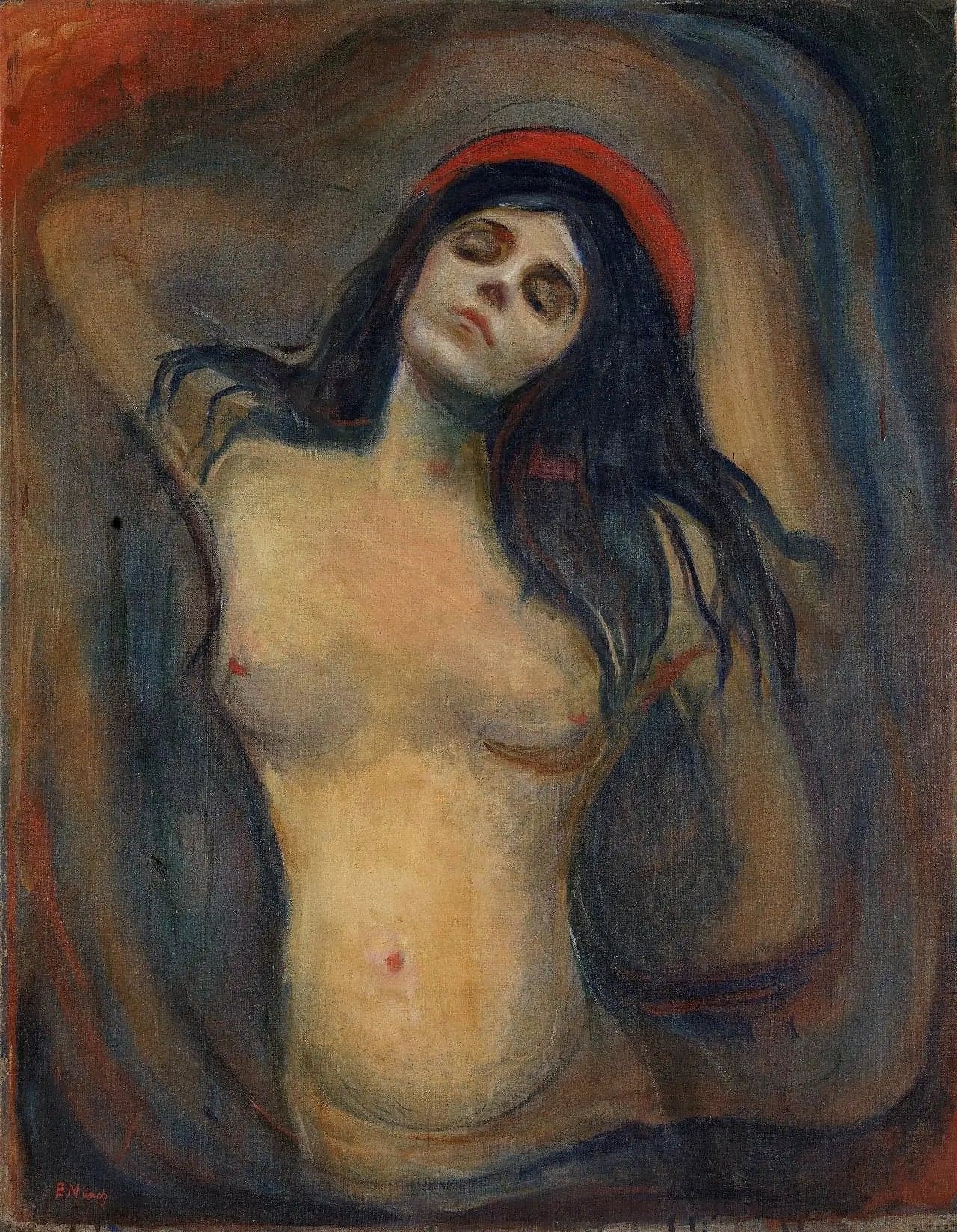
The Madonna
- Original dimensions
- 70.5 x 90.5 cm
- Movement
- expressionism
- Museum
- National Gallery of Oslo
- Year
- 1894
Scene depicted
In this powerful painting, Munch addresses universal themes such as motherhood, desire, and pain. A woman, the central figure, is depicted with a haunting beauty, surrounded by a luminous halo, which contrasts with the dark shadows that envelop her. The composition of the painting invites us to dive into this duality of emotions, translating the complexity of human relationships and the inner struggles of the soul.
Historical context
Created in 1894, the iconic painting La Madonne by Edvard Munch is part of the expressionist movement, a period when art seeks to express intense emotions rather than represent reality literally. In Oslo, at the heart of Norway, this canvas was born, immersed in a rich and troubled cultural context, where matter and emotion meet. Today, the painting is preserved in the National Gallery of Oslo, a prestigious setting where visitors can admire its striking dimensions of 70.5 x 90.5 cm.
Place in the artist's career
La Madonne occupies a prominent place in the career of Edvard Munch , symbolizing a stage of artistic maturation. This painting reveals itself in continuity with his previous works, such as The Scream and The Dance of Life , revealing his relentless quest to explore the depths of human emotions. Through La Madonne , Munch takes us further into a form of expression of his complex psychological universe.
Anecdote
“Art is the reflection of the soul.” This is a quote that could perfectly summarize the essence of Edvard Munch . It was in a moment of contemplation, on a gentle spring morning, that Munch sketched the first ideas for this masterpiece . Each brushstroke carries a visceral emotion, rooted in the realities of his life and that of his time, highlighting the evocative power of La Madonne .
Major exhibitions
Europeana 280