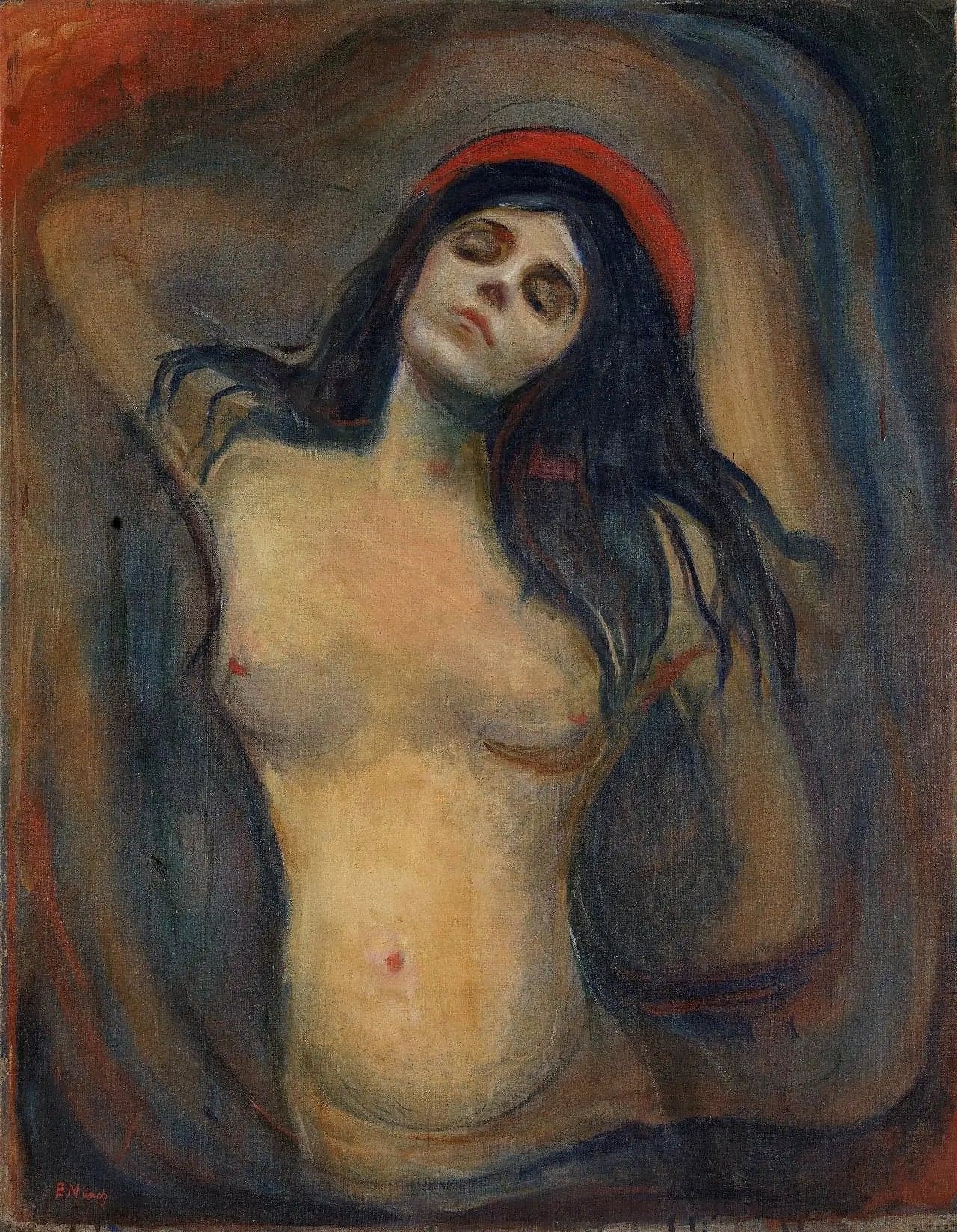
The Madonna
- Original dimensions
- 70.5 x 90.5 cm
- Movement
- expressionism
- Museum
- National Museum
- Year
- 1894
Scene depicted
This canvas immerses us in a world that is both celestial and earthly. The figure of the Madonna, thoughtfully engraved, stands out as an icon of motherhood, where love and pain coexist. With a haunting tenderness, the work depicts the complexity of emotions that bind the mother to her child. The swirling lines of the canvas create a captivating dynamic, drawing us into a poignant dialogue between tenderness and melancholy.
Historical context
Created in 1894, in Oslo, the painting "The Madonna" emerges at the heart of expressionism , a movement that explodes with passion and emotion. This iconic canvas , contemporary to the tumultuous reflections of the late 19th century, is today preserved in the National Museum. Its imposing dimensions reveal an intense pictorial universe, where every detail breathes the soul of a troubled era.
Place in the artist's career
Positioning "The Madonna" as a central piece in the career of Edvard Munch , this painting marks a turning point towards artistic maturity. It stands alongside "The Scream" and "The Dance of Life", forming a triptych of intense emotions, where Munch's new technique embraces anguish and euphoria. Through this canvas , Munch enriches his flamboyant sensitivity, revealing a resigned humanity in the face of desires and sufferings.
Anecdote
Edvard Munch once stated: "Pain is a teacher, joy a muse." In this masterpiece , he draws his inspiration on a spring morning, contemplating a woman in fragile health, who embodies both beauty and suffering. The light filtering through the leaves of the trees evokes an atmosphere laden with pendulum, a moment suspended between life and the beyond, resonating at the very heart of "The Madonna".
Major exhibitions
Europeana 280