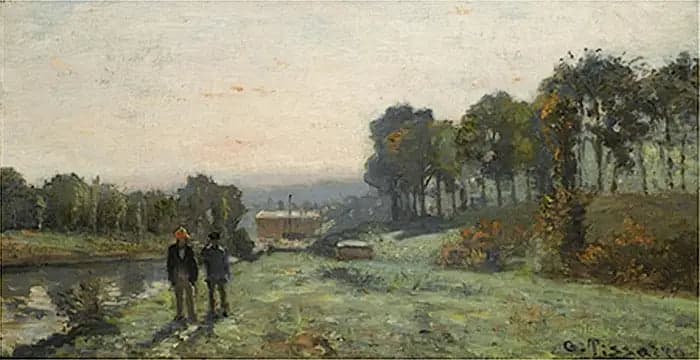
The Machine of Marly at Bougival
- Original dimensions
- 45 x 23.5 cm
- Museum
- Not specified
- Year
- 1869
Scene depicted
This painting depicts the famous hydraulic machine, a remnant of a bygone era, majestically standing by the water's edge, evocative of a time when technology and natural beauty coexisted. The bucolic banks of Bougival, covered in lush flora, invite peace and reflection. A snapshot of everyday life, this painting embodies the harmony between man and nature, a theme that remains relevant.
Historical context
Created in 1869, this remarkable painting is set in the picturesque town of Bougival, a quiet commune near Paris, at the heart of the Impressionist era. Through this canvas , Camille Pissarro captures the very essence of a time when light and color reigned supreme in the artistic landscape. This iconic painting , although unknown in current museums, remains a true testament to a movement that redefined modern art.
Place in the artist's career
The Machine of Marly in Bougival is part of a period of maturity for Pissarro, where his style is marked by bold compositions and a continuous exploration of light. With works such as The Garden of Pontoise and The Potato Harvest , Pissarro demonstrates a technical evolution, moving from the rigor of academicism to the vibrant luminosity of Impressionism .
Anecdote
“Art is the best way to see the world,” Pissarro is said to have murmured while contemplating this enchanting landscape. On a sunny spring morning, bathed in the gentle light of day, he drew his inspiration from this majestic view, observing the ballet of oars on the Seine and listening to the song of birds awakening to the morning dew. The Machine of Marly in Bougival was thus born from this moment of wonder, making tangible the Impressionist philosophy.