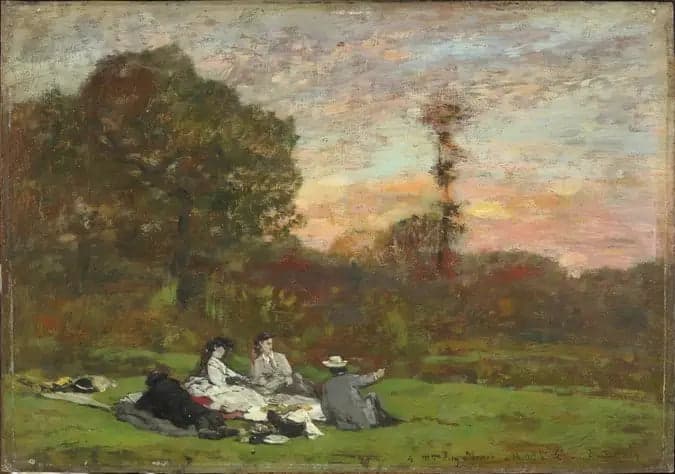
The Luncheon on the Grass
- Original dimensions
- 25 x 17.5 cm
- Museum
- Orsay Museum
- Year
- 1866
Scene depicted
This painting evokes a pastoral scene, where figures gather around a picnic blanket, celebrating the beauty of the outdoors and the simplicity of life's joys. In a light and joyful atmosphere, this pictorial work embodies the harmony between man and his environment, capturing a fleeting moment in the soft light of the sun's rays.
Historical context
This painting , created in 1866, is set in the enchanting framework of the French Second Empire. The canvas is currently displayed at the Orsay Museum , an iconic place in Paris, where every visitor can discover this artistic heritage. The painting reflects the emerging Impressionist movement, characterized by the exploration of light and outdoor life.
Place in the artist's career
The Luncheon on the Grass represents an important turning point in Boudin's career. At that time, the artist, often considered a precursor of Impressionism , asserts himself alongside contemporaries such as Claude Monet and Camille Pissarro. Compared to his earlier paintings like The Beach at Trouville and The Boats of Honfleur , this canvas illustrates the evolution of his technique regarding light and composition.
Anecdote
“I have always sought to capture the soul of a moment, to bring forth light on the canvas, like a breath of nature.” This quote could summarize a key moment during the creation of The Luncheon on the Grass , when one spring morning, Eugène Boudin sat in a meadow, captivated by the gentle murmur of the surrounding nature and the intoxicating scent of flowers.