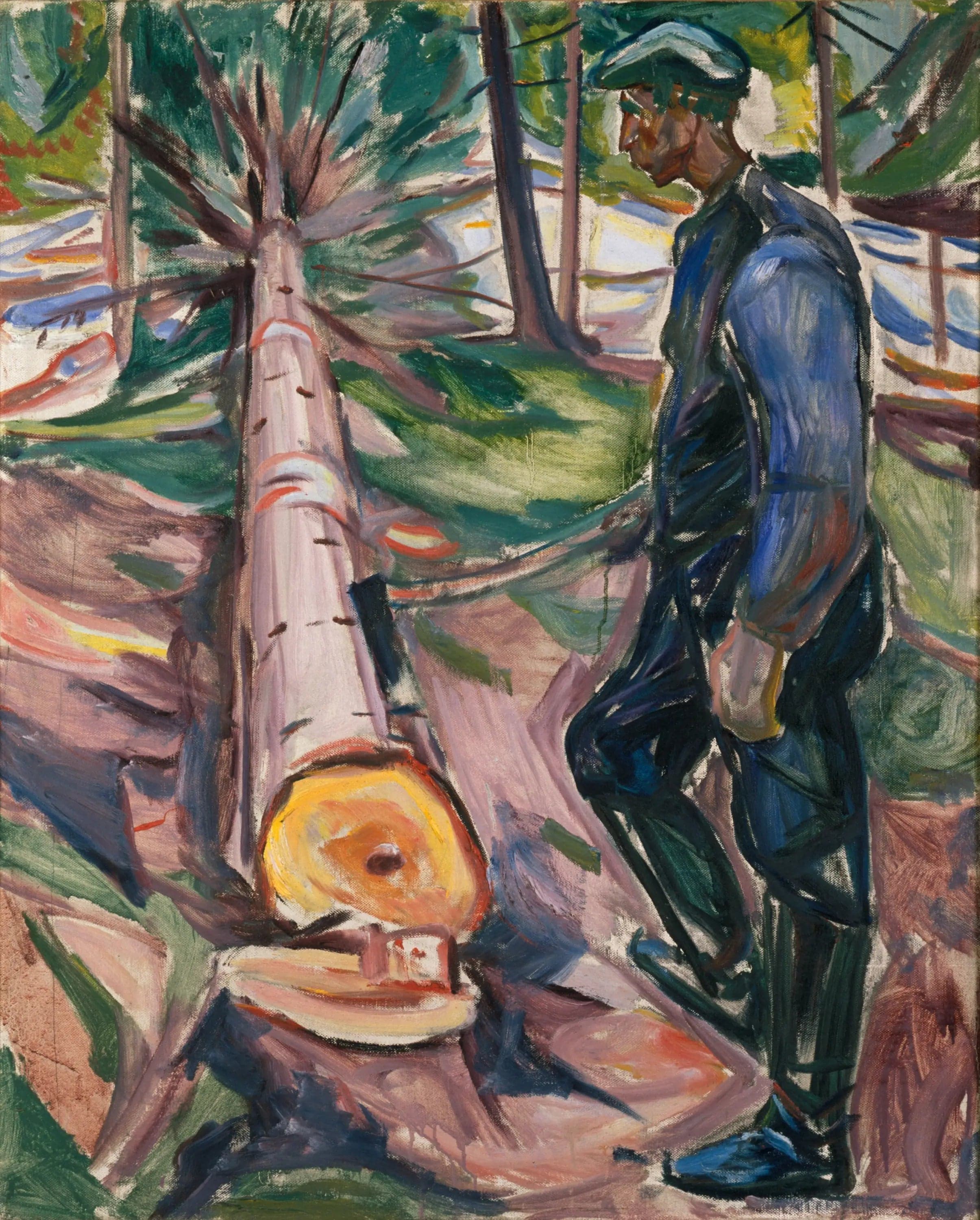
The Lumberjack
- Original dimensions
- 105.5 x 130 cm
- Museum
- Munch Museum
- Year
- 1913
Scene depicted
The painting “The Lumberjack - Edvard Munch ” powerfully depicts a man in full action, harnessed to his task, in symbiosis with nature. Each swing of the axe is a dance between man and tree, a struggle between the inner and outer worlds. The soft light filters through the leaves, enveloping the scene in a cocoon of serenity despite the palpable effort.
Historical context
Created in 1913, this painting finds its origin in Oslo, Norway, a place marked by an artistic upheaval that saw the birth of the expressionist movement. In a context where the human psyche is a subject of exploration, The Lumberjack fits into this quest for the soul through the canvas. Currently, this painting rests in the Munch Museum, a sanctuary dedicated to the work of this visionary artist, whose imposing dimensions, 105.5 x 130 cm, testify to its monumental character.
Place in the artist's career
Created at a turning point in his career, The Lumberjack marks a stage of maturity. Echoing previous works like The Madonna and The Scream , this painting reveals an increased mastery of color and emotions, evolving Munch's work towards a more intense exploration of the human being and its struggles.
Anecdote
“Each painting is like a breath that one inhales, a memory that one captures.” In recalling this moment of creation, Munch was inspired by a misty morning in the mountains, where the song of birds and the crackling of fresh wood converged to awaken in him a unique vision. This vibrant memory is etched in the evocative power of The Lumberjack .
Major exhibitions
Edvard Munch . Monumental projects