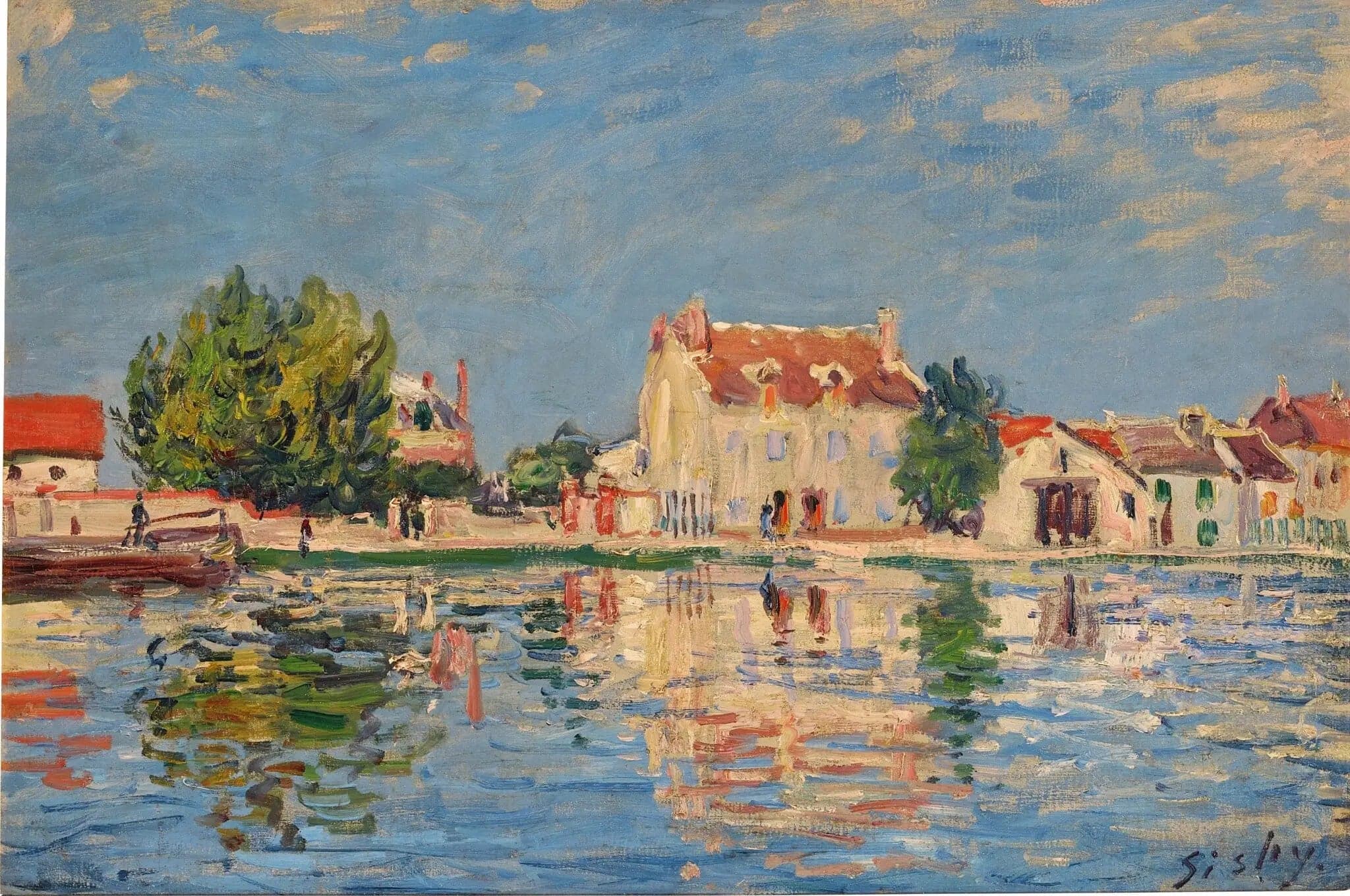
The Loing Canal at Saint-Mammès
- Original dimensions
- 55 x 38.5 cm
- Museum
- Von-der-Heydt Museum
- Year
- 1884
Scene depicted
In this pictorial work , Sisley transports the viewer to the heart of a bucolic scene, where the slow flow of the Loing mourns the tranquility of the surrounding nature. The peaceful atmosphere is accentuated by gentle reflections on the water of the canal, suggesting a perfect harmony between man and nature, and elegantly embodying the Impressionist ideal dear to the painter.
Historical context
Created in 1884, this painting is one of the emblematic works of Alfred Sisley , a great master of the Impressionist movement. Located in Saint-Mammès, a charming French commune on the banks of the Loing, this canvas captures the softness of the French landscape at a time when visual impressions and plays of light began to fascinate artists. The painting is currently on display at the Von-der-Heydt Museum , where it continues its dialogue with visitors, carefully preserved for all its historical and artistic imprint.
Place in the artist's career
The Canal du Loing at Saint-Mammès represents a pivotal period in the career of Alfred Sisley , marked by an increased affinity for river landscapes. This painting stands out alongside other works such as “The Bridge of Churant” or “Snow at Louveciennes,” illustrating a stylistic maturation and a deep exploration of variations in light and atmospheres.
Anecdote
“The landscape is a melody for which I tirelessly seek harmony.” Alfred Sisley envisioned his painting as an invitation to discover the beauty of the places his eyes beheld. On that sunny morning in Saint-Mammès, every reflection on the water must have captivated his gaze, bringing his masterpiece to life.