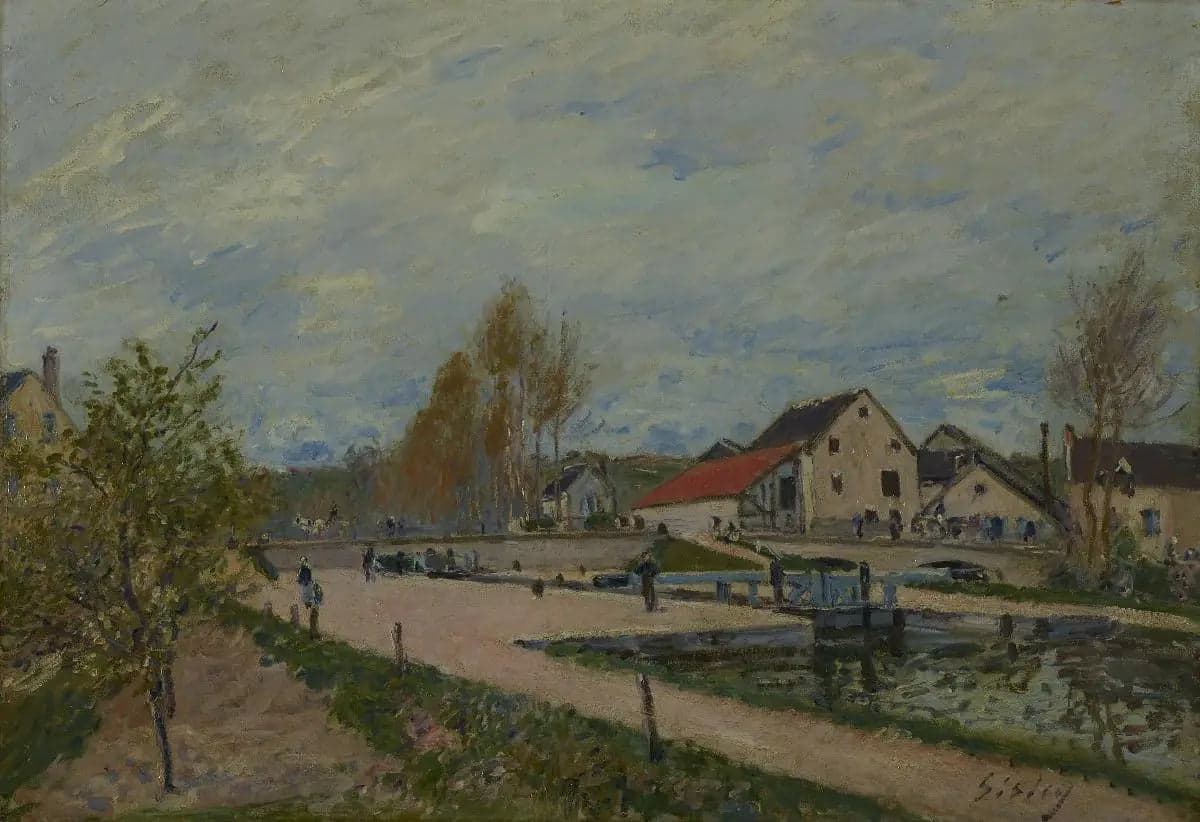
The Lock of Burgundy at Moret-sur-Loing
- Original dimensions
- 73.5 x 51 cm
- Museum
- Museum of Art and History of Geneva
- Year
- 1882
Scene depicted
This painting evokes the serenity of the banks of the Loing, where fishing boats glide peacefully on the clear waters. The painting depicts a scene of daily life, rhythmically punctuated by the movement of the boatmen and the play of reflections in the water. Sisley captures not only the forms but also the vibrant atmosphere of this iconic place, making this canvas a pictorial work that transcends the simple moment.
Historical context
Created in 1882, this painting is located in the charming town of Moret-sur-Loing, in Île-de-France. Almédée Sisley, a major figure of the Impressionist movement, immortalizes through this canvas the luminous harmony of the river landscapes of his time. Today, this painting is preserved in the collections of the Museum of Art and History of Geneva , thus testifying to its importance in the artistic heritage of the 19th century.
Place in the artist's career
The Lock of Burgundy at Moret-sur-Loing is situated at a key moment in Alfred Sisley's career, marking his full stylistic maturity. At this time, he asserts himself as a master of light and atmospheres. This painting can be paralleled with Monet's “Impression, Sunrise” and “The Seine at Argenteuil,” where the exploration of reflections and plays of light reaches its peak.
Anecdote
“In every lighting, nature reinvents itself.” This quote, imbued with the sensitivity of Alfred Sisley , evokes the genesis of this masterpiece . Nourished by a gentle spring morning, Sisley allows himself to be inspired by the murmur of the waters and the song of the birds, in front of the lock that becomes for him a canvas vibrant with life and emotions. The painting is not just a representation, but the reflection of an eternal moment.