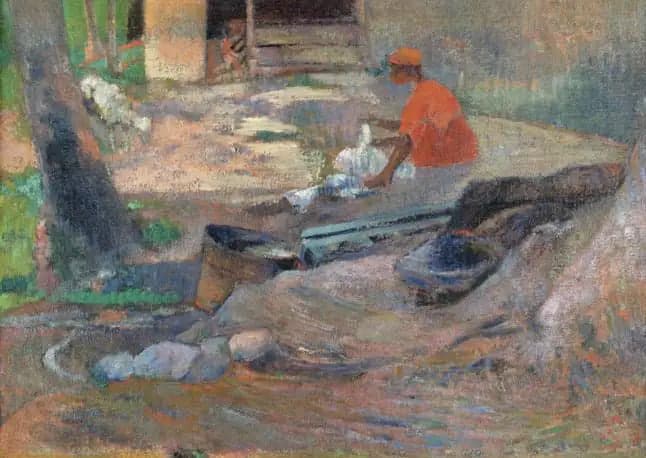
The Little Washer
- Original dimensions
- 45.1 x 32.4 cm
- Museum
- Not specified
- Year
- 1887
Scene depicted
In this pictorial work , Paul Gauguin captures a scene of rural life, where a woman is seen hard at work, washing laundry by the riverbank. Her posture and expression, turned towards the water, evoke both melancholy and serenity. The vibrant colors, typical of Gauguin's style, infuse warmth into this simple moment, transforming an ordinary task into a scene of poignant beauty.
Historical context
Created in 1887, this painting embodies its roots in Pont-Aven, Brittany, where the post-impressionist movement gives rise to bold artists. At that time, Gauguin, inspired by the wild landscape and local culture, develops a canvas marked by his quest for an introspective and colorful expression. Although the painting is not currently displayed in a known museum, it remains a valuable testimony of the artistic era that saw it born.
Place in the artist's career
The Little Washer fits into a pivotal period of Gauguin's career, illustrating his departure from conventional artistic norms. At this time, he develops a unique style, where symbolic components and vibrant colors coexist. By comparing it with The Error, painted a few years later, one observes an evolution towards bolder forms and themes more deeply rooted in spirituality.
Anecdote
“I seek the truth beyond appearances, in the depths of souls.” These words from Gauguin resonate as an ode to his masterpiece. Imagine him, one spring morning in Pont-Aven, his eyes fixed on a washerwoman absorbed in her task, the sound of water splashing against the stones, and a golden light filtering through the trees. This raw emotion crystallizes in The Little Washer.