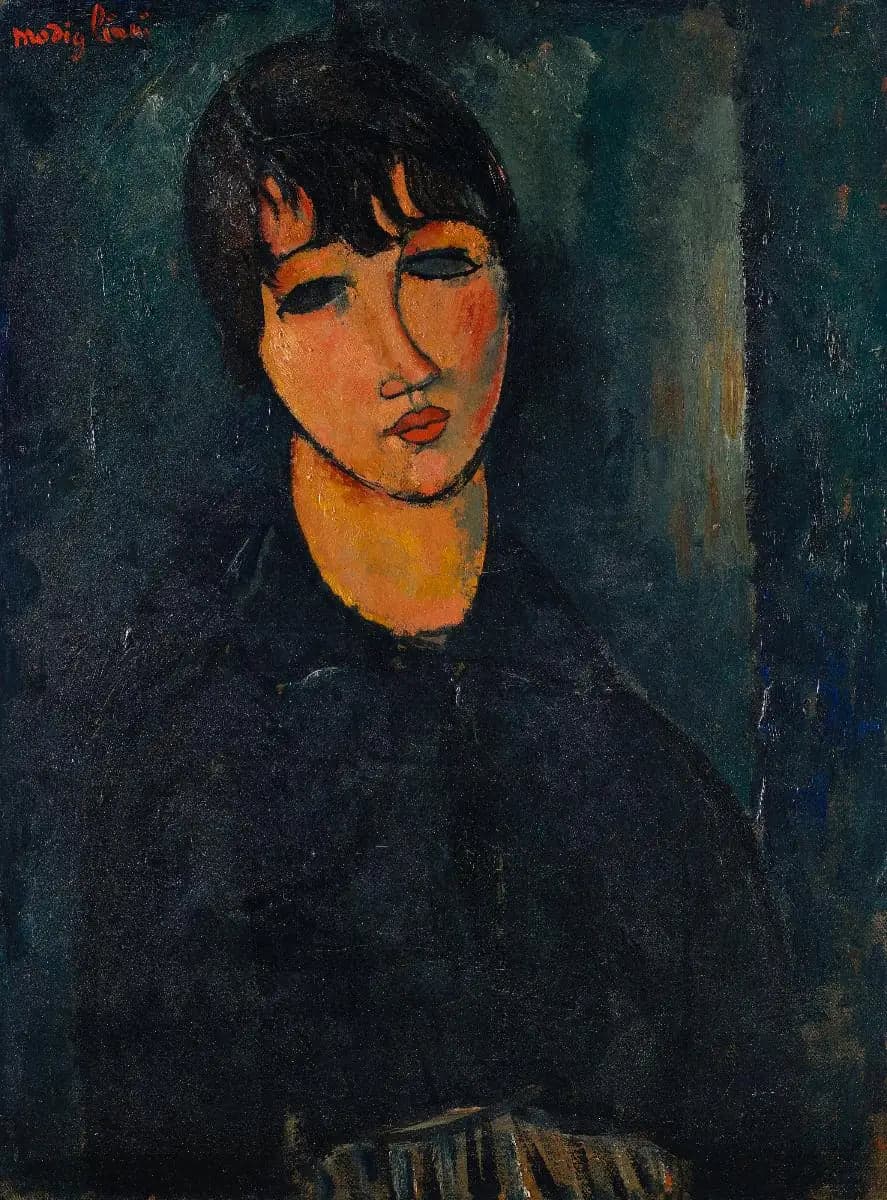
The Little Servant
- Original dimensions
- 54 x 73 cm
- Museum
- Kunsthaus Zurich
- Year
- 1916
Scene depicted
In this composition , Modigliani captures a young maid with delicate beauty, frozen in a posture of contemplation. Her presence, imbued with melancholy, reveals a deep sensitivity and an invitation to introspection. The painting unveils an intimate universe where the personality of the model transcends reality, offering a glimpse into her inner life. Thus, the expression in her gaze becomes a reflection of buried aspirations and dreams.
Historical context
Created in 1916, in the charming setting of Paris, this legendary painting is part of the artistic movement of modernism . The tumultuous period of World War I shaped the soul of this canvas . Today, the painting rests honorably within the walls of the Kunsthaus Zurich , a temple of art that breathes history and creativity. Its harmonious dimensions, 54 x 73 cm, testify to the miniature elegance that Modigliani was able to capture.
Place in the artist's career
The Little Maid holds crucial importance in Modigliani's career, marking a phase of artistic maturity. The work is situated between two other iconic creations: Reclining Nude and Portrait of Jeanne Hébuterne . While the former illustrates his mastery of forms and bodies, the latter reveals the psychological depth of the model, while paving the way for the richness of the canvas currently celebrated.
Anecdote
“In every face, there is a story to tell, a soul to explore.” Thus declared Modigliani, inspired by a peaceful alley in Montparnasse, where in the early morning, soft lights caressed the face of the young maid. This pictorial work evokes the pure emotion of these simple moments, an instant connection between the artist and his model.