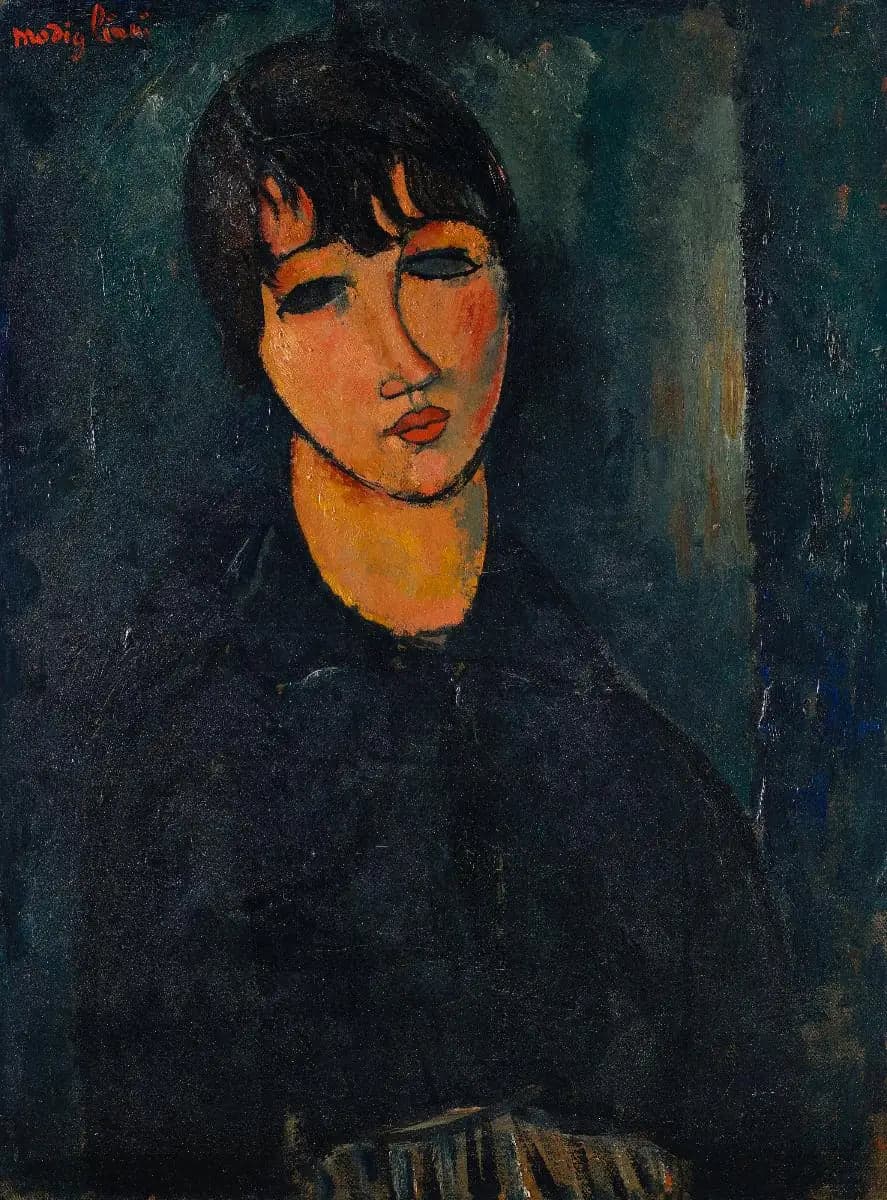
The Little Servant
- Original dimensions
- 54 x 73 cm
- Museum
- Kunsthaus Zurich
- Year
- 1916
Scene depicted
The composition of The Little Servant focuses on the peaceful face of a young girl, dressed in a simple dress. This painting captures the innocence and serenity of her posture, with eyes that seem to bear the weight of the world while evoking infinite softness. Each brushstroke preserves a story, that of a life intertwined with dreams and desires as well as the beauty of simple things.
Historical context
Created in 1916, at the crossroads of modernism and post-impressionism , The Little Servant reveals itself as a vibrant testimony of the artistic Paris of the time. It is in this city, bubbling with creativity, that Amedeo Modigliani , influenced by fauvism and cubism , leaves his mark with his elongated forms and expressive faces. Currently, this painting resides in the Kunsthaus Zurich , where it continues to evoke the soul of its time with its delicate dimensions.
Place in the artist's career
Positioned as one of the milestones of Modigliani's maturity, The Little Servant illustrates his distinctive style, where stylized forms and melancholic features intertwine. Alongside Portrait of Paulette (1915) and Reclining Nude (1917), one can observe how the artist merges spirituality and empathy, placing himself at the peak of his career.
Anecdote
“Beauty lies in the gaze we cast upon the world,” Modigliani might have said during the creation of this pictorial work . Inspired by fleeting moments, he absorbed the atmosphere of a spring morning, when the air, laden with promises, floated through the streets of Montparnasse, revealing the simplicity and depth of his subject.