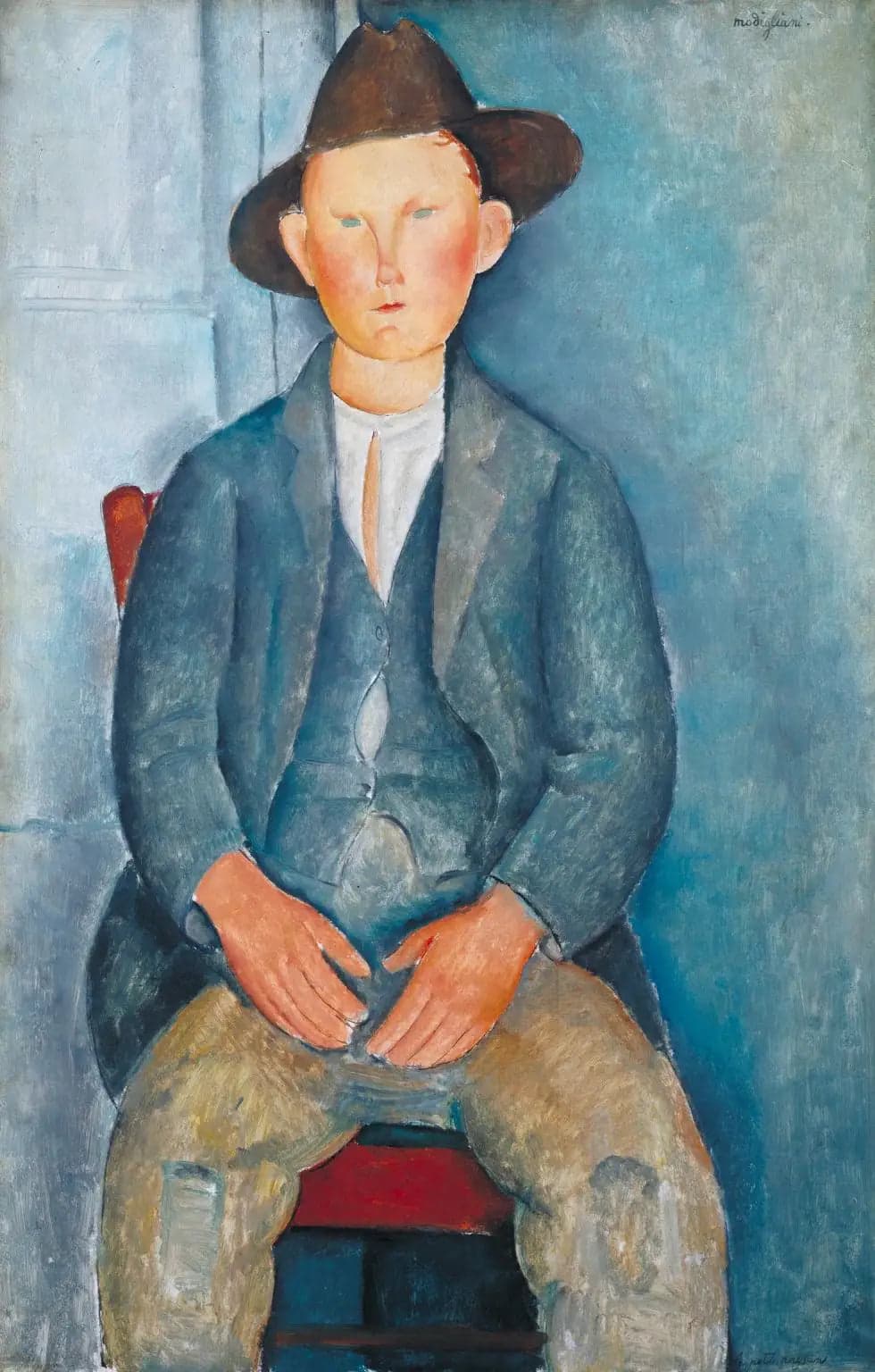
The Little Peasant
- Original dimensions
- 64.5 x 100 cm
- Museum
- Tate Britain
- Year
- 1918
Scene depicted
In this canvas , we discover a farmer, a true symbol of authenticity and simplicity, who embodies the dignity of labor. Modigliani brings this character to life through elongated forms and warm colors, evoking both melancholy and the strength of human nature. The tension between rurality and modernity is expressed subtly, immersing the viewer in a suspended moment of everyday life.
Historical context
Created in 1918, during a time when Europe was still healing from the wounds of World War I, this painting emblematic comes from the charming city of Nice, a place where the artist found refuge and inspiration. Modigliani, a leading figure of the expressionist movement, managed to capture the very essence of lived life, which can be observed in this unique pictorial work. Currently preserved at the Tate Britain, this canvas of generous dimensions invites exploration and contemplation.
Place in the artist's career
The Little Peasant marks a turning point in Modigliani's career, a reflection of his artistic maturity. After notable works like The Young Girl in Black and The Great Nude , this painting demonstrates a desire to return to more down-to-earth themes, while maintaining his unique sense of aesthetics and color.
Anecdote
Modigliani once declared: "Art should not only be seen, it should be felt." It was during a sunny morning in Nice, while observing workers in the fields, that he decided to create the masterpiece we know today as The Little Peasant . The shade of the trees and the scent of the earth were muses that guided him.