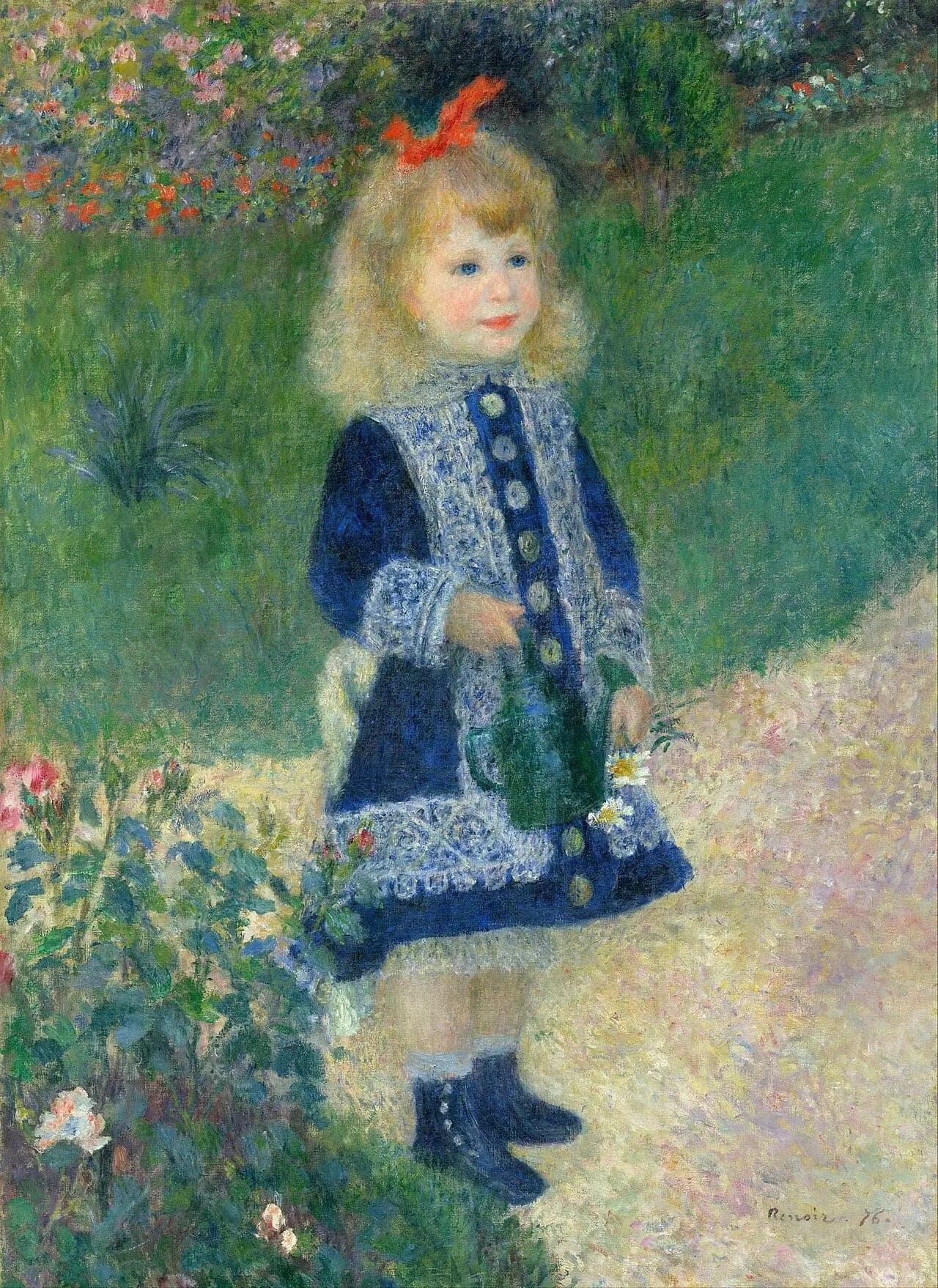
The Little Girl with the Watering Can - Pierre
- Original dimensions
- 73 x 100 cm
- Museum
- National Gallery of Art
- Year
- 1876
Scene depicted
In this canvas , we discover a scene full of tenderness and freshness. The little girl, immersed in her innocent play, waters flowers, full of life and curiosity. Renoir invites us to share this moment of daily happiness, to appreciate the simple pleasures of childhood, and to immerse ourselves in a world governed by light and color.
Historical context
Created in 1876, this painting by the famous Impressionist Auguste Renoir finds its origin in Paris, a city vibrant with culture and creativity. This canvas , emblematic of the Impressionist movement, testifies to a time when light and color took precedence over the strict realism of previous artistic currents. Today, the painting is located at the National Gallery of Art , preserved in all its splendor, ready to captivate every gaze with its generous dimensions.
Place in the artist's career
The Little Girl with the Watering Can stands as an emblematic work of the promising beginnings of Auguste Renoir . It is a painting that anticipates his later works, such as Luncheon of the Boating Party and The Frog Pond, where the joy of living and the brilliance of light intertwine more than ever. With this painting , Renoir begins to explore the effects of light and the fluidity of forms, laying the groundwork for his artistic evolution.
Anecdote
“Light is the caress of nature,” Renoir said. On a gentle spring morning, while observing a little girl blowing joyful rituals through a watering can, he was carried away by this idyllic vision. This fleeting moment gave birth to a masterpiece , where each brushstroke evokes the innocence and freedom of a carefree youth, capturing the very essence of the little girl.