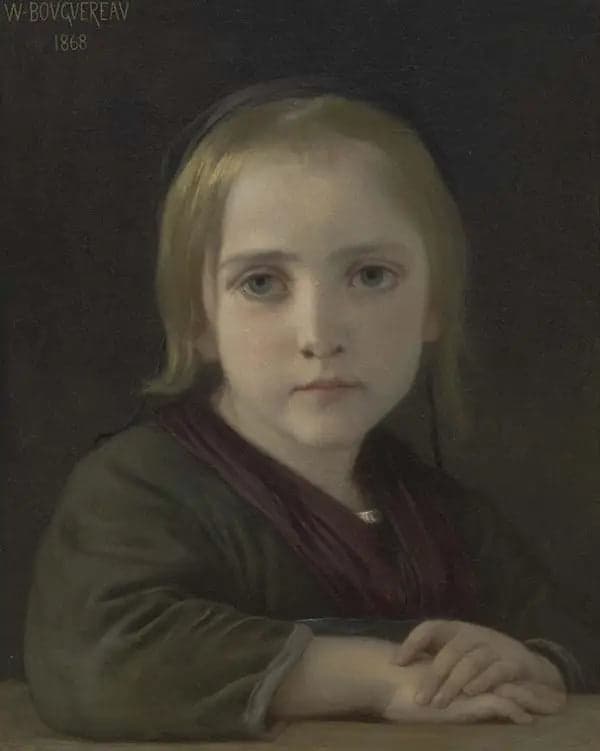
The Little Girl with Blue Eyes
- Original dimensions
- 34 x 42 cm
- Museum
- Raclin Murphy Museum of Art
- Year
- 1868
Scene depicted
In this composition , a little girl stands there, her eyes sparkling and full of curiosity, enveloped by a soft light that seems to come from another world. The canvas captures this ephemeral moment, where innocence and beauty combine to touch us deeply. Every detail, from the delicate veil that surrounds her to the warm tones of her radiant complexion, tells us a silent yet profound story.
Historical context
Created in 1868, this painting is emblematic of the vast artistic heritage of France in the 19th century. Bouguereau is part of the academic movement, where the excellence of realism meets ideal beauty. The canvas is currently displayed at the Raclin Murphy Museum of Art, an institution that passionately and rigorously celebrates art, much like the work itself, measuring 34 by 42 centimeters.
Place in the artist's career
This painting represents not only the stylistic peak of Bouguereau but also a significant milestone in his career, marked by the evolution of his style. In parallel, other works like “The Harvesters” and “The Virgin and Child” showcase his ability to capture human emotion through striking portraits. The Little Girl with Blue Eyes thus fits into an aesthetic continuity, demonstrating him as one of the great masters of realism .
Anecdote
William-Adolphe Bouguereau once stated: “Beauty is the truth of the soul.” Perhaps this is what his gaze captured that morning when he encountered the sweet face of a little girl with azure blue eyes in a sunlit alley. This fleeting meeting inspired this masterpiece , a work that evokes, with every brushstroke, the tenderness of childhood and lost innocence.