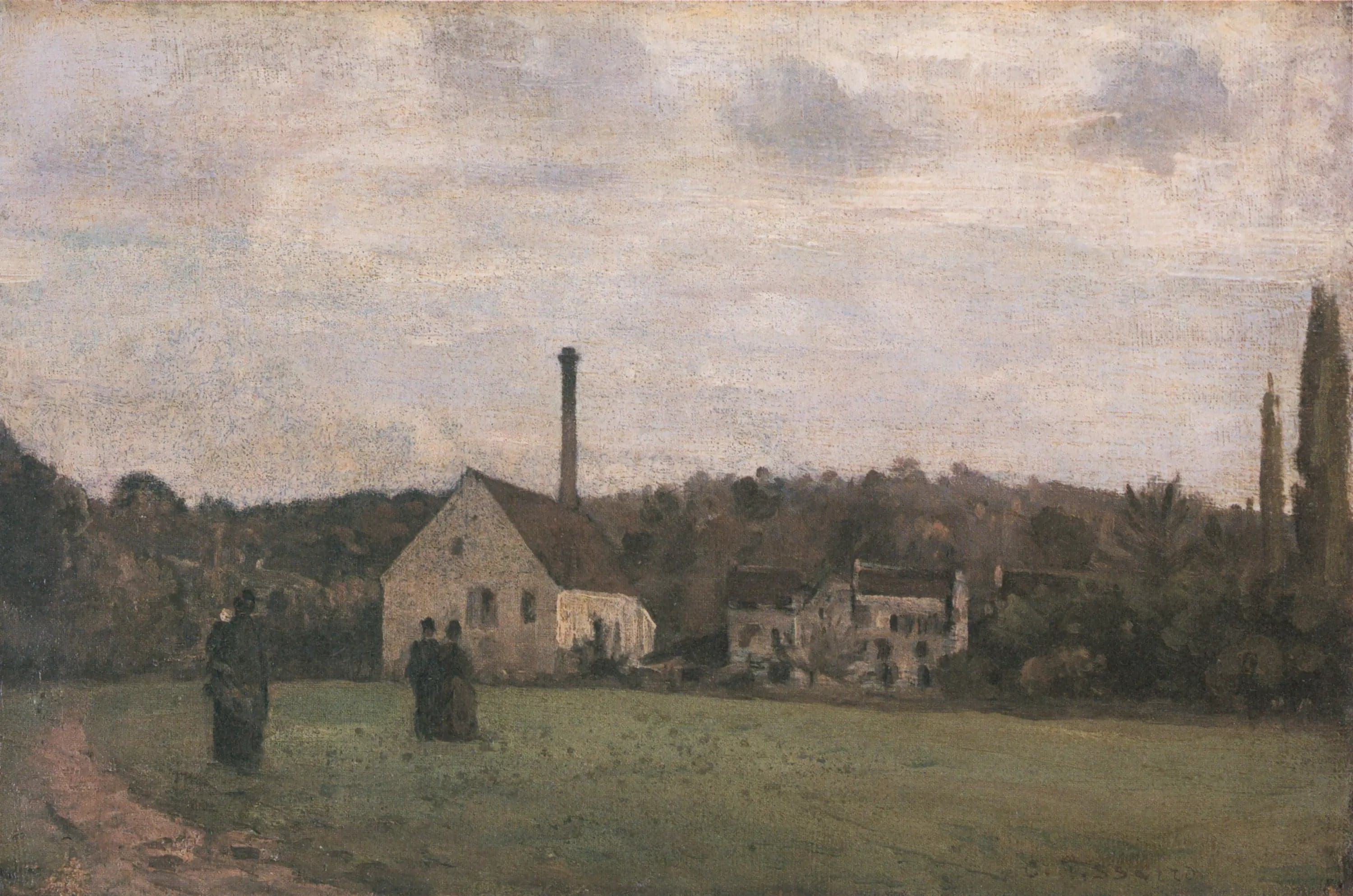
The Little Factory
- Original dimensions
- 40.2 x 26.5 cm
- Museum
- Museum of Modern and Contemporary Art of Strasbourg
- Year
- 1868
Scene depicted
The composition of the painting "The Little Factory" reveals a scene of innocent and everyday activity. Within the fragile walls of the modest factory, a group of workers is immersed in their task, thus testifying to the discreet yet essential labor of their lives. The conviviality that flourishes through gestures, exchanges, and the light streaming through the windows highlights a palpable harmony – a suspended moment that Pissarro brilliantly immortalized.
Historical context
Created in 1868, the iconic canvas by Camille Pissarro , "The Little Factory," is set against the vibrant backdrop of the Impressionist movement born in Paris. In the heart of Alsace, in Strasbourg, this painting is an artistic representation that captures the very essence of an era when artists and intellectuals aspired to a free expression of life. Today, this masterpiece is preserved in the Museum of Modern and Contemporary Art of Strasbourg, a city rich in history and culture.
Place in the artist's career
"The Little Factory" stands as a pivotal work in the career of Camille Pissarro , marking the beginning of a lively exploration of scenes from rural and urban life. In parallel with his other iconic paintings such as "The Seine at Eragny" and "Boulevard Montmartre, Spring," this canvas reflects his artistic evolution towards a more immersive approach to light and color.
Anecdote
“The light of a summer morning on the rooftops of the city reminds me of the warmth of childhood memories. It is there that I found the inspiration for my painting.” These words from Pissarro evoke a moment of encounter between the artist and his subject. Coming to life on this canvas, the emotion intertwines with the natural beauty of the scene, where each brushstroke resonates like a gentle whisper of nature.