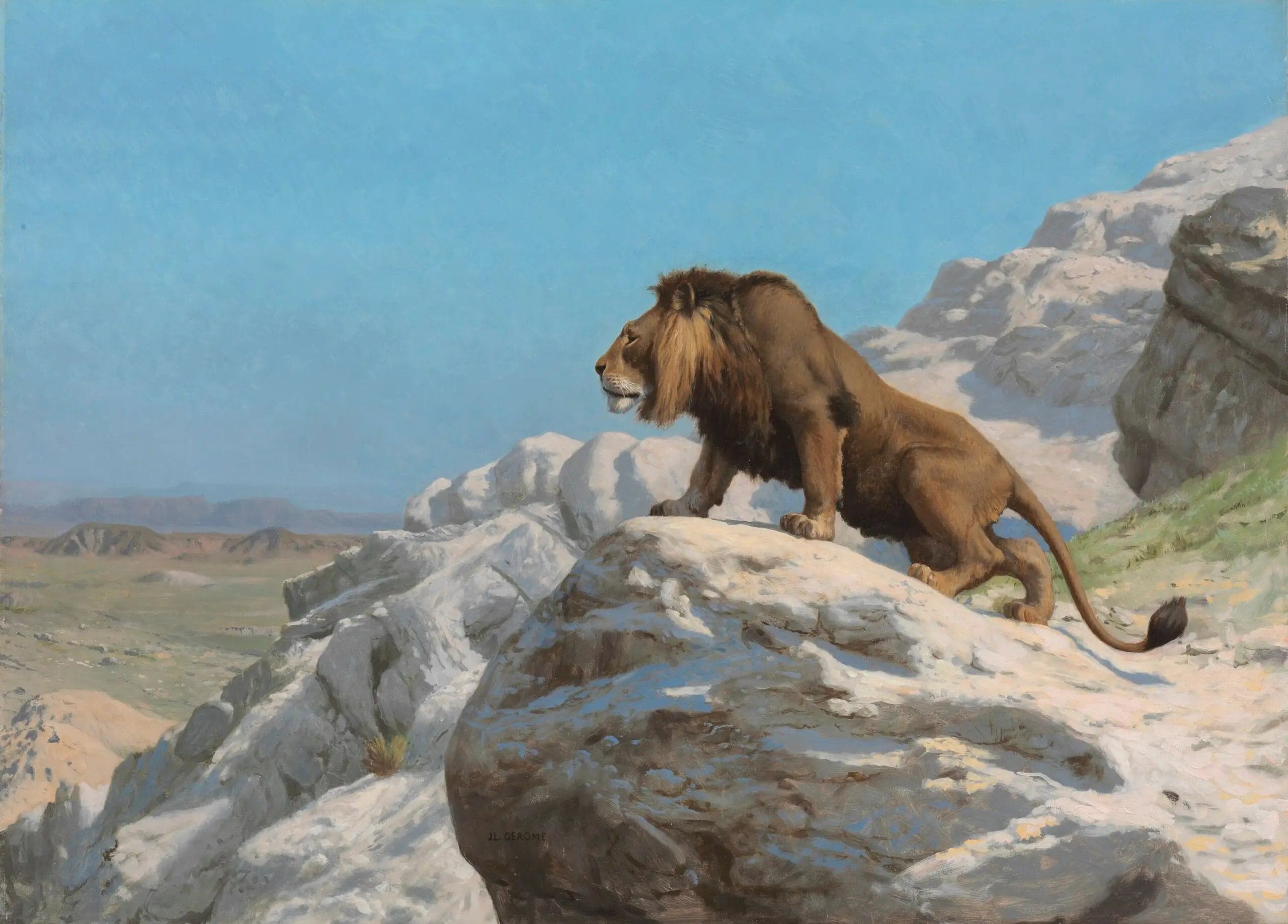
The Lion on the Watch - Jean
- Original dimensions
- 100.5 x 72.3 cm
- Museum
- Cleveland Museum of Art
- Year
- 1885
Scene depicted
This painting features a majestic lion, frozen in a posture of attention, shadow and light playing on its golden fur. The dynamic composition allows the viewer to feel the suspended moment, where every detail matters, creating palpable tension. Gérôme's pictorial work does not merely represent an animal; it tells a story, a quest for survival, a piercing gaze into the African savanna, where the spirit of the beast reveals itself.
Historical context
Created in 1885, the painting The Lion at Bay is at the heart of a France undergoing artistic transformation, where realism and academicism meet. Jean-Léon Gérôme , an iconic figure of the 19th century, is part of this era that advocates meticulous attention to detail and dramatic staging. Currently exhibited at the Cleveland Museum of Art , this painting beautifully sized at 100.5 x 72.3 cm is not only a striking canvas but also a valuable witness to a period rich in artistic innovations.
Place in the artist's career
“The Lion at Bay” fits into Gérôme's prolific career, illustrating his stylistic peak at the end of the 19th century. Alongside other paintings such as “Pollice verso” and “The Dance of the Dancers,” one can observe the evolution of his technical and emotional approach, from striking realism to the psychological depth of the subjects on stage.
Anecdote
“Every brushstroke is a call to nature,” said Gérôme while contemplating the landscapes that inspired him so much. Imagine him, on a sunny morning, strolling down a street in Paris, the vibrant colors of spring flowers blending with the golden light reflecting on the cobblestones. It is in this effervescent atmosphere that the inspiration for his formidable masterpiece , The Lion at Bay , was born, powerfully evoking the majesty and incredible tension of the animal world.