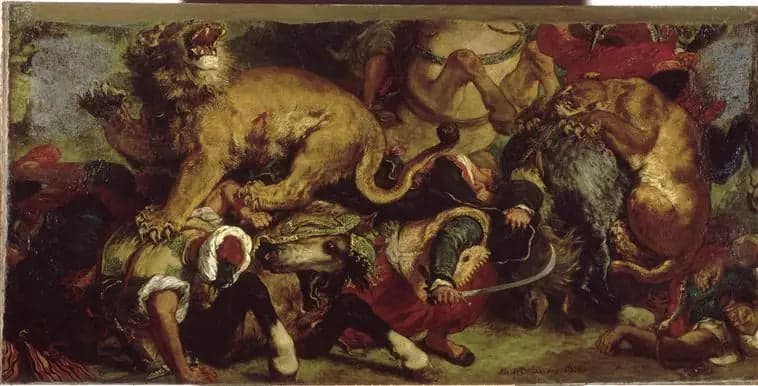
The Lion Hunt
- Original dimensions
- 360 x 175 cm
- Movement
- Orientalism
- Museum
- Bordeaux Museum of Fine Arts
- Year
- 1855
Scene depicted
In this canvas , Delacroix takes us to the heart of a savanna where majestic lions stand against the hunters. The palpable tension between man and beast is heightened by expressive gestures and a dynamic sense of movement. Every detail, from the glints of weapons to the silent roars of the beasts, brings this pictorial work to life, imbued with striking realism and wild poetry.
Historical context
Created in 1855, in Bordeaux, this painting is an iconic representation of the spirit of the Orientalist movement. Through this canvas , Eugène Delacroix depicts a scene marked by exoticism and the majesty of wildlife, a window into a world that is both wild and fascinating. Its current location, at the Bordeaux Museum of Fine Arts, allows visitors to immerse themselves in this spectacular artwork, rich in 360 x 175 cm of visual intensity.
Place in the artist's career
This painting stands at a pivotal point in Delacroix's career, representing a stylistic peak where he masters sensations while exploring Eastern themes that will mark his journey. At the crossroads between “ Liberty Leading the People ” and “ The Death of Sardanapalus ”, The Lion Hunt illustrates the artist's significant evolution between a romantic approach and a bolder, more gestural language.
Anecdote
“The light of a summer morning illuminates the creatures depicted, just as the artist's soul finds its reflection in each of my works.” This imagined quote could well summarize the very essence of this masterpiece . The hunting scene, striking and dynamic, resonates with Delacroix's passionate love for nature, vibrating with emotions at the heart of this painting .
Major exhibitions
1855 World Exposition