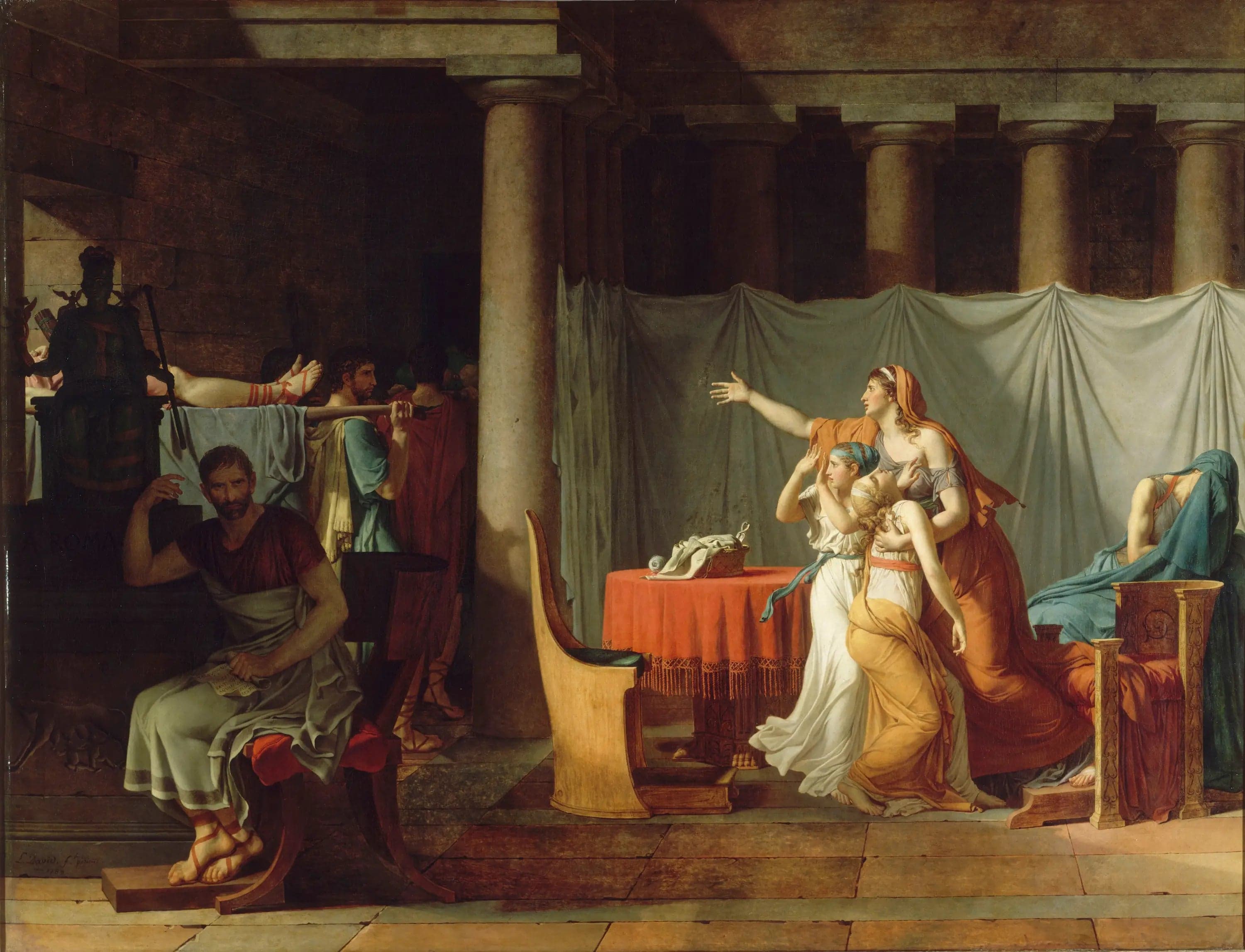
The Lictors Bringing Back to Brutus the Bodies of His Sons - Jacques
- Original dimensions
- 422 x 323 cm
- Movement
- neoclassicism
- Museum
- Room 702
- Year
- 1789
Scene depicted
This monumental canvas represents an emblematic moment of ancient Rome, where lictors bring to Brutus the bodies of his sons, condemned for betraying the homeland. This painting does not merely display a historical narrative; it imposes its emotional weight, illustrating the dilemma of duty and paternal love, enclosed within a framework of great dramatic tension.
Historical context
Created in 1789, this painting illustrates the peak of the neoclassical movement in Paris, a crossroads of culture and revolutionary ideas. The canvas is set against a backdrop of political and social upheaval, offering a powerful reflection on honor and sacrifice. Today, the painting is housed in room 702 of an iconic museum, whose generous dimensions transcend the mere status of a work of art.
Place in the artist's career
The Oath of the Horatii marks a major turning point in David's career, representing a stylistic peak at the dawn of his success. In parallel with his earlier works such as The Oath of the Horatii and his later creations, this painting manifests his evolution towards a more intense and tragic approach to painting .
Anecdote
“Art is the cry of the soul in turmoil,” might have said Jacques-Louis David when recalling the genesis of his masterpiece , inspired by an autumn morning, where the melancholy of fallen leaves whispers the tragic story of Brutus and his sons. The original emotion of this painting still resonates powerfully, touching the hearts of viewers.
Major exhibitions
Salon of 1789