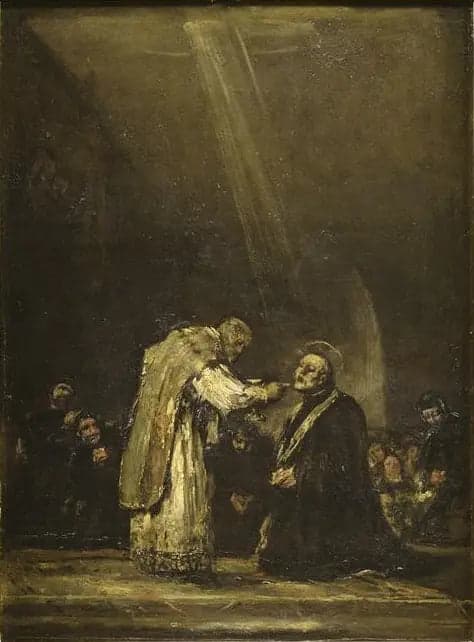
The Last Communion of San José de Calasanz
- Original dimensions
- 33.5 x 45.3 cm
- Museum
- Bonnat-Helleu Museum
- Year
- 1817
Scene depicted
In accordance with the great religious tradition, The Last Communion of San José de Calasanz depicts the solemn moment when the saint receives the Eucharist. In an atmosphere saturated with emotion, the golden light enhances the faces, each expression telling a story of surrender and devotion. The protagonists, enveloped in a halo of hope, seem to transcend time and space, inviting the viewer to a meditative contemplation.
Historical context
With an unalterable imprint, The Last Communion of San José de Calasanz emerges from an early 19th century Spain, shaken by social and political upheavals. Imbued with the romantic movement, this painting embodies the very essence of a moment where art intertwines with spirituality. Currently exhibited at the Bonnat-Helleu Museum, this sublime painting of 33.5 x 45.3 cm reveals an artistic project deeply rooted in its time.
Place in the artist's career
This painting , stemming from Goya's artistic maturity, positions itself between two of his other great works : "The Disasters of War" and "The Naked Maja". Together, they testify to a bold technical evolution, illustrating the transition from a social and political vision to an introspective, personal, and spiritual quest.
Anecdote
"Each painting is an open window to a universe one wishes to share." On a spring morning in the year 1817, Goya is said to have found inspiration while wandering through the aisles of a monastery. The whispers of prayers and the soft light filtering through the veils of faith nourished this pictorial work , transforming each brushstroke into a divine invocation.