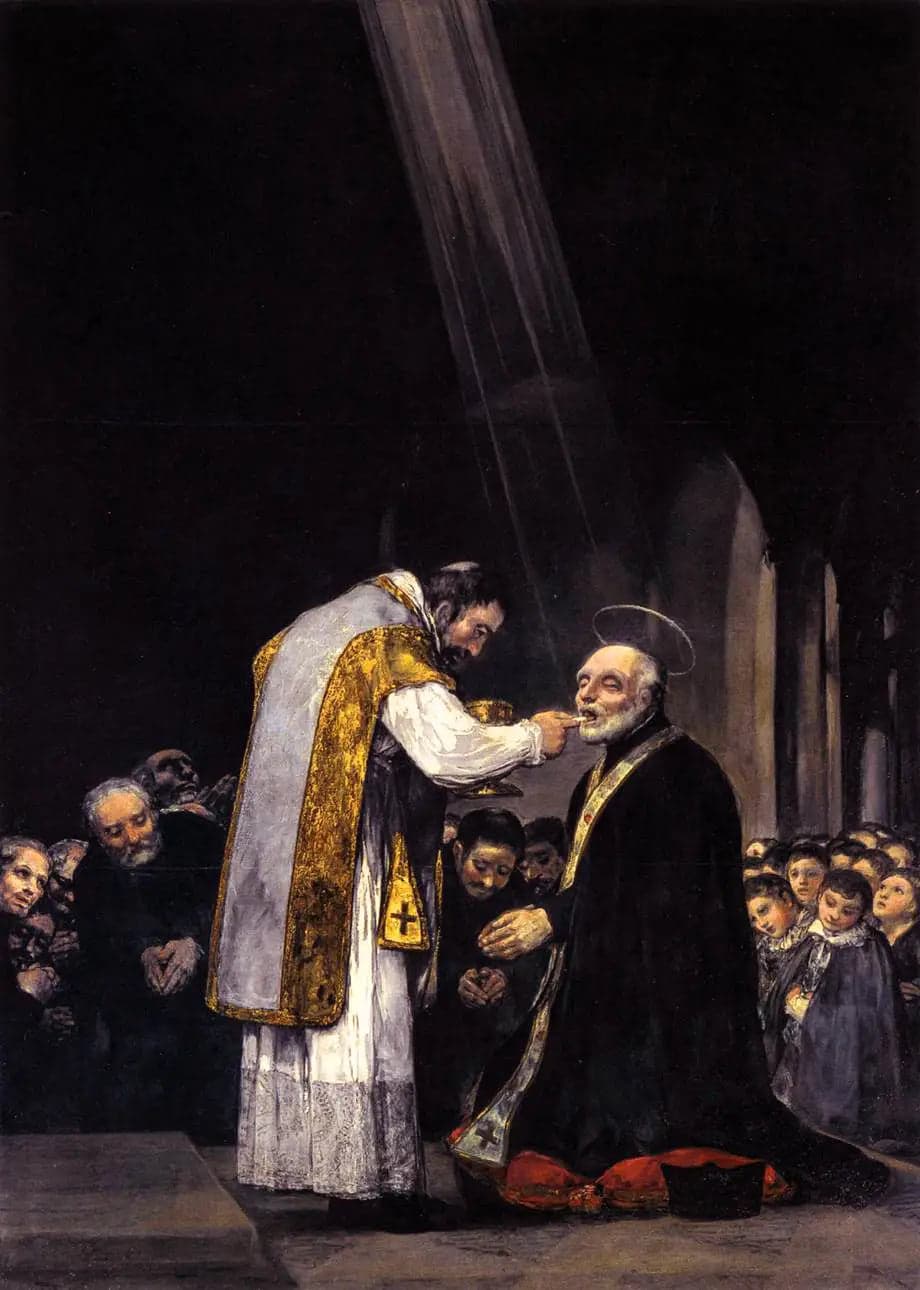
The Last Communion of Saint Joseph Calasanz
- Original dimensions
- 180 x 250 cm
- Museum
- Villanueva building
- Year
- 1819
Scene depicted
This pictorial work illustrates a poignant scene of the saint's last communion, a moment of intense spirituality where divine grace meets humanity. The figures, filled with emotion, gather around the saint who undoubtedly feels a divine embrace in his final moments. In this composition, life and death intertwine, highlighting the fragile beauty of existence.
Historical context
Created in 1819, this painting is an iconic work, the result of the Spanish genius Francisco de Goya , set in a historical context marked by the political and social turmoil of post-Napoleonic Spain. The canvas is currently housed in the Villanueva building, a setting that respects the majestic dimensions of 180 x 250 cm, reflecting the grandeur of its composition. Goya, a major figure of the romantic movement, uses this work as a means to explore the spiritual and humanistic themes of his time.
Place in the artist's career
The Last Communion of Saint Joseph Calasanz represents a turning point in Goya's career, marking the peak of his mature style. In parallel with works such as The Third of May 1808 and The Naked Maja, this masterpiece defines his technical and emotional evolution, revealing an introspective depth in his subjects.
Anecdote
“Melancholy enters the human heart like a shadow at twilight.” These words could be those of Goya, evoking the moment of inspiration in an alley in Madrid, as the cloister where Saint Joseph Calasanz preached resonates with the whisper of prayers. A golden light floods the scene, enhancing the feelings of devotion that emanate from this painting .