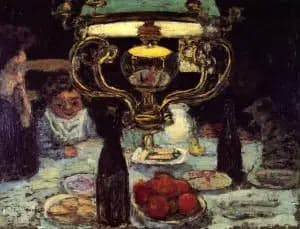
The Lamp
- Original dimensions
- 70.5 x 54 cm
- Museum
- Not specified
- Year
- 1899
Scene depicted
In this canvas , Bonnard immerses the viewer in an intimate universe, where the simplicity of a corner of a room is sublimated by the play of lights. The lamp, at the center of the scene, becomes a true muse, illuminating everyday objects with an almost nostalgic tenderness. The warm colors and harmonious composition invite us to explore this moment suspended in time, where every detail seems to whisper a forgotten story.
Historical context
Created in the artistic context of the late 19th century, this painting is part of the post-impressionist movement, characterized by the subjective expression of emotions and the exploration of light. Pierre Bonnard , whose work flourished between tradition and innovation, offers us here a unique composition, a witness of his time. Although the canvas is not displayed in a specific museum today, its dimensions and character make it an essential pictorial work in the evolution of modern art.
Place in the artist's career
The Lamp represents a turning point in Bonnard's career, marking his period of prolific creativity. This painting is situated among other notable works, such as “The Gardens” and “The Terrace” – two canvases emblematic of his ability to capture light and space. Here, Bonnard's artistic maturity emerges, revealing his unique journey and growing mastery of color and form.
Anecdote
“Art is capturing light in the fleeting moment.” This phrase resonates as a striking truth in the genesis of this masterpiece . Inspired by the softness of a spring morning, Bonnard captured a diffused light that dances around the lamp, creating not only an image but a vibrant atmosphere. The inspiration arose from a simple evening at home, illuminated by the gentle glow of a lamp, revealing both the beauty of the everyday and the intensity of emotions.