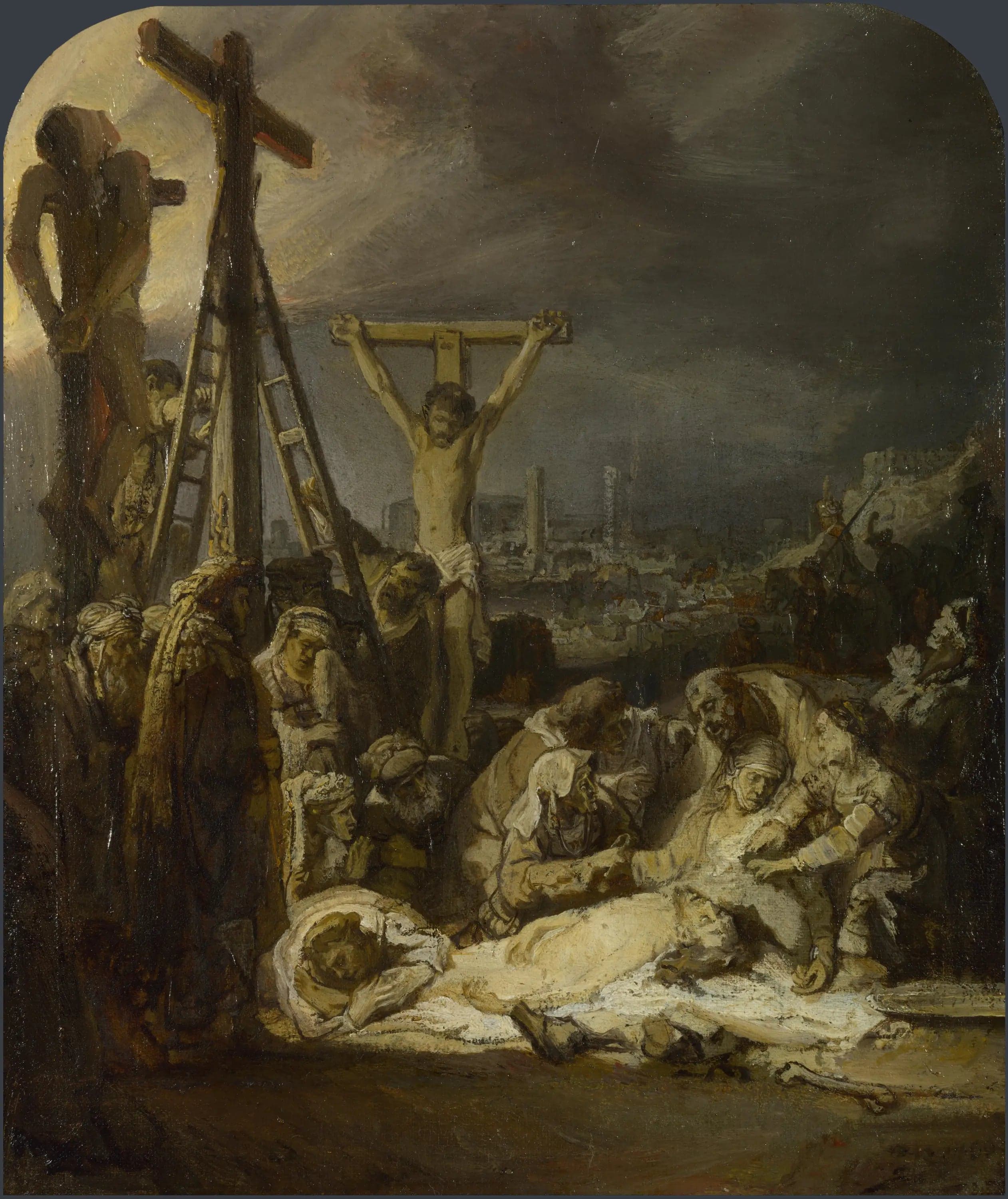
The Lamentation over the Dead Body of Christ
- Original dimensions
- 26.7 x 31.9 cm
- Museum
- National Gallery
- Year
- 1635
Scene depicted
This pictorial work represents a poignant scene of lamentation, where the lifeless body of Christ is surrounded by the distraught figures of those who loved him. Each character, with their own palpable suffering, seems to embody universal emotions of pain, loss, and empathy. The way Rembrandt captures this deep sadness, while playing with light and shadow, further enhances the dramatization of the composition.
Historical context
Created in 1635, in the historic city of Amsterdam, this painting is at the heart of the Baroque movement, a period where light and shadow intertwine with intensity. Rembrandt , undisputed master of chiaroscuro, infused his canvas with an emotional depth that has endured through the centuries. Currently, this canvas is carefully preserved at the National Gallery, where it continues to amaze visitors from around the world.
Place in the artist's career
The Lamentation over the Dead Body of Christ marks a turning point in Rembrandt's career, signifying a transition to deeper and more introspective compositions. Compared to works such as The Night Watch and The Flight into Egypt, this canvas illustrates a mastery of emotional drama and a remarkable technical evolution. It is a testament to a period of maturity where the artist explores the human soul with disconcerting intensity.
Anecdote
“Intense pain transforms into light” could have said Rembrandt in front of his masterpiece , aware that each brushstroke captures suffering and love. Inspired by a misty morning, a deep silence, he found in each expression of the characters gathered around Christ a profound evocative force, linking the painting to the human soul.