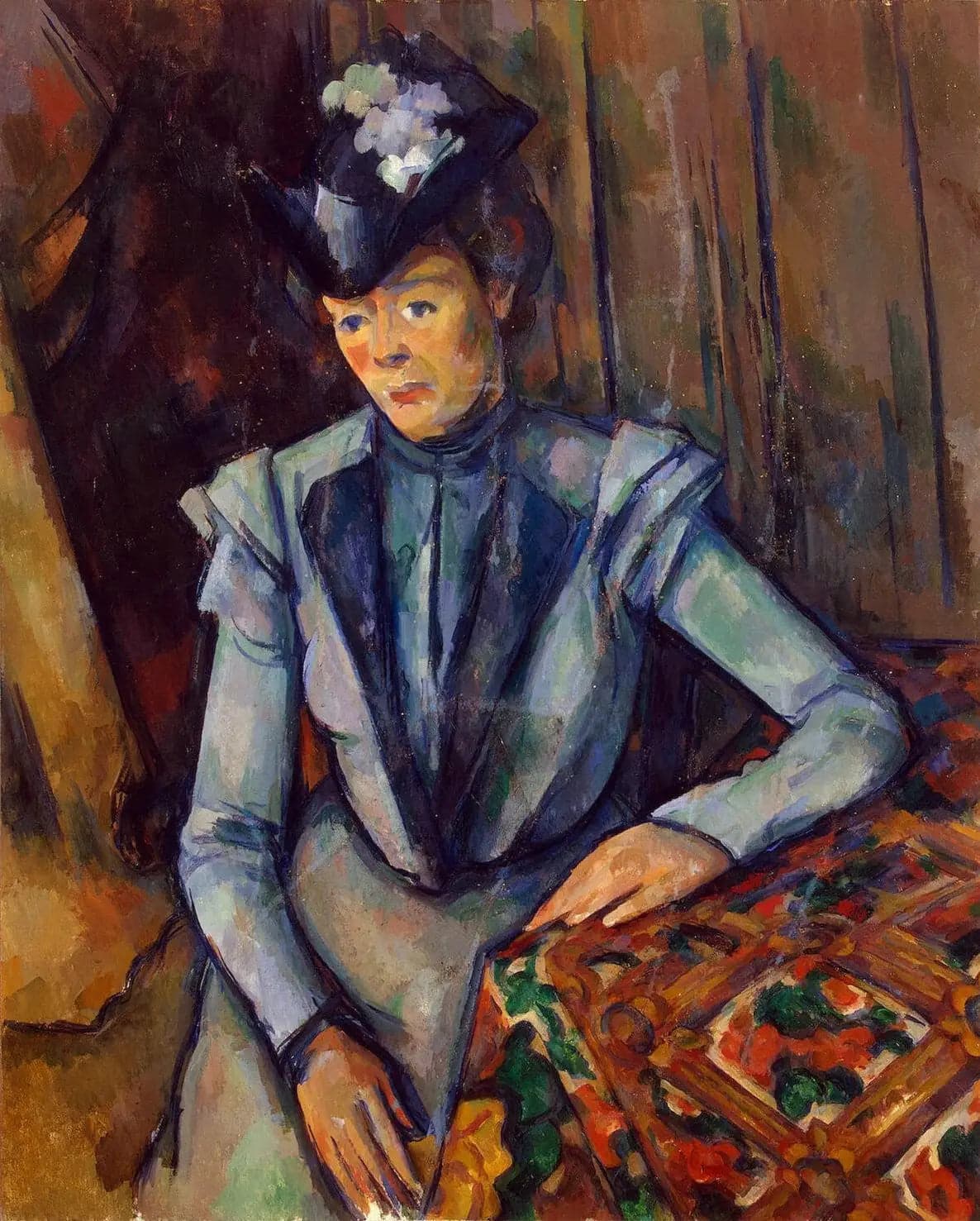
The Lady in Blue
- Original dimensions
- 73.5 x 90 cm
- Movement
- post impressionism
- Museum
- Hermitage Museum
- Year
- 1904
Scene depicted
In The Lady in Blue , Cézanne stages an elegantly dressed woman, wrapped in a deep blue dress. The admiring gaze gets lost in the softness of her features, while a blurred background evokes the light filtering through the drapes of a peaceful interior. This canvas is not just a simple representation; it is a tribute to the silent beauty and intimacy of moments passed, captured at the very heart of the French soul.
Historical context
Created in 1904, in the heart of France, the painting titled The Lady in Blue brilliantly fits into the artistic movement of post impressionism . At that time, Paul Cézanne , residing in Provence, was redefining the contours of pictorial art with an innovative approach. This canvas measuring 73.5 x 90 cm is currently preserved at the prestigious Hermitage Museum , Saint Petersburg, a place that celebrates the artistic treasures of history.
Place in the artist's career
The Lady in Blue symbolizes a turning point in Cézanne's career, a passage where the fluidity of his touch marries an unprecedented power of expression. At that time, he had already signed other emblematic canvases , such as The Card Players and Mont Sainte-Victoire , marking a pivotal period of maturity. By connecting these works, one discovers a rich evolution, both technically and emotionally, celebrating the greatness of the master's post impressionist pictorial art.
Anecdote
“I aspire to capture the essence of each moment, each of my paintings is a conversation with the world.” This thought illuminated every brushstroke of Cézanne, in tune with the morning lights dancing on the roofs of his city. Perhaps it was a spring morning when this pictorial work came to life, celebrating the fleeting beauty of everyday life, like a gentle breath on the canvas .