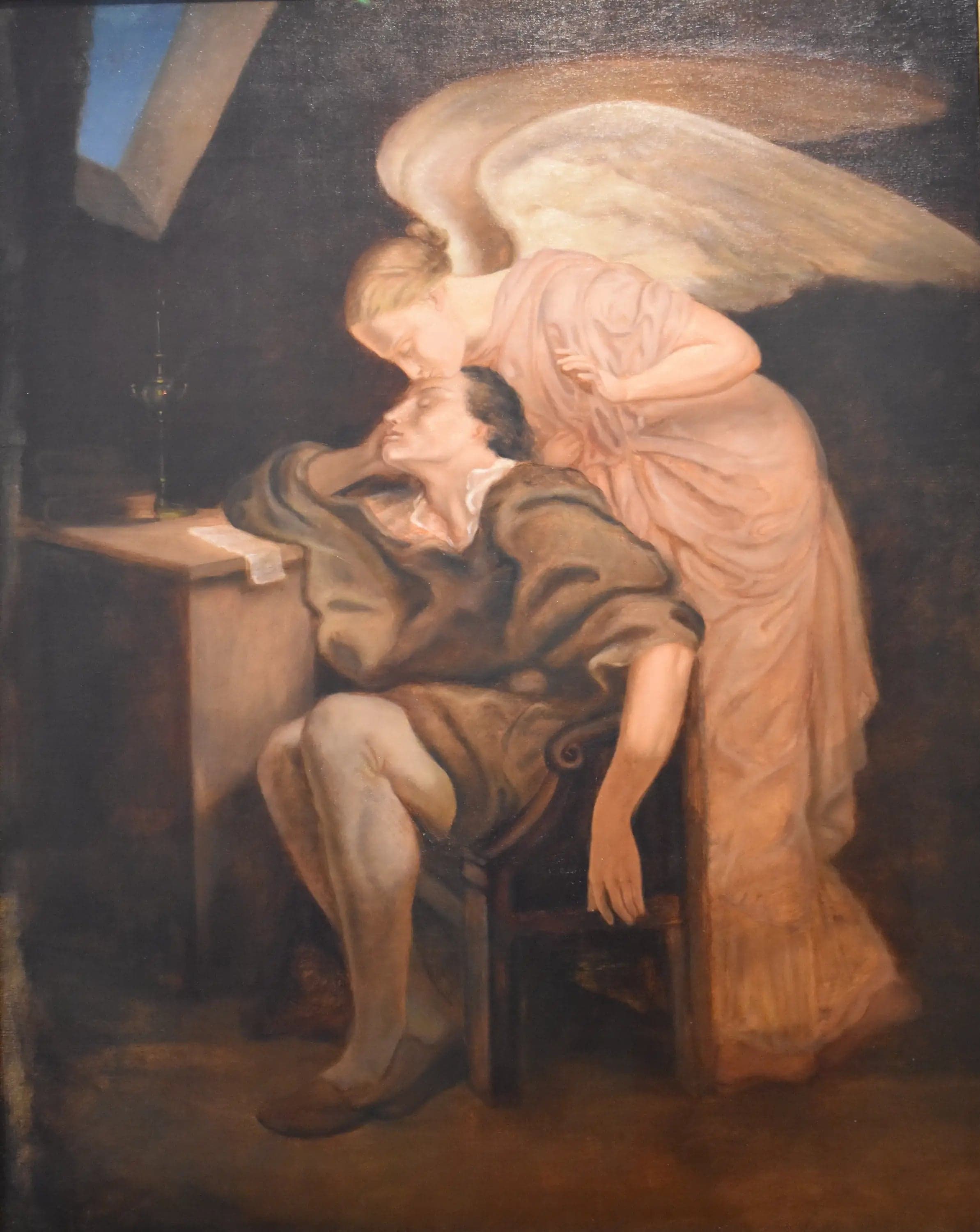
The Kiss of the Muse, after Frillié
- Original dimensions
- 66 x 82 cm
- Museum
- Granet Museum
- Year
- 1860
Scene depicted
The painting "The Kiss of the Muse, after Frillié" depicts a fusion moment between an artist and his muse, a symbol of inspiration and summer passion. Delicate gestures and captivating emotions intertwine to form a harmonious composition. This pictorial work evokes a meeting suspended in time, at the crossroads of unwavering love and unquenched creativity.
Historical context
This painting , created in 1860, comes to life in the picturesque setting of Aix-en-Provence, the artist's birthplace. At the time, Cézanne is influenced by the emerging Impressionist movement, which he merges with a more structured and geometric approach, characteristic of his work. Currently, this canvas enchants visitors at the Granet Museum, where the dimensions deserve contemplation, offering a significant emulation of the artist's creative moment.
Place in the artist's career
The Kiss of the Muse occupies a prominent place in Cézanne's career, a transition between his beginnings and his period of artistic maturity. At the time, this canvas already reveals the beginnings of his future innovations. For comparison, one can mention "The Montagne Sainte-Victoire" and "The Card Players," two other iconic creations that illustrate this technical and emotional evolution in his artistic sum.
Anecdote
Cézanne once slipped these words: "Each canvas is an exploration of beauty in motion.” Inspired by the lights of a gentle morning, he would have crossed the gaze of a muse, unconsciously, as he let himself be intoxicated by the sensations of spring. This original emotion is imprinted in the evocative power of The Kiss of the Muse .