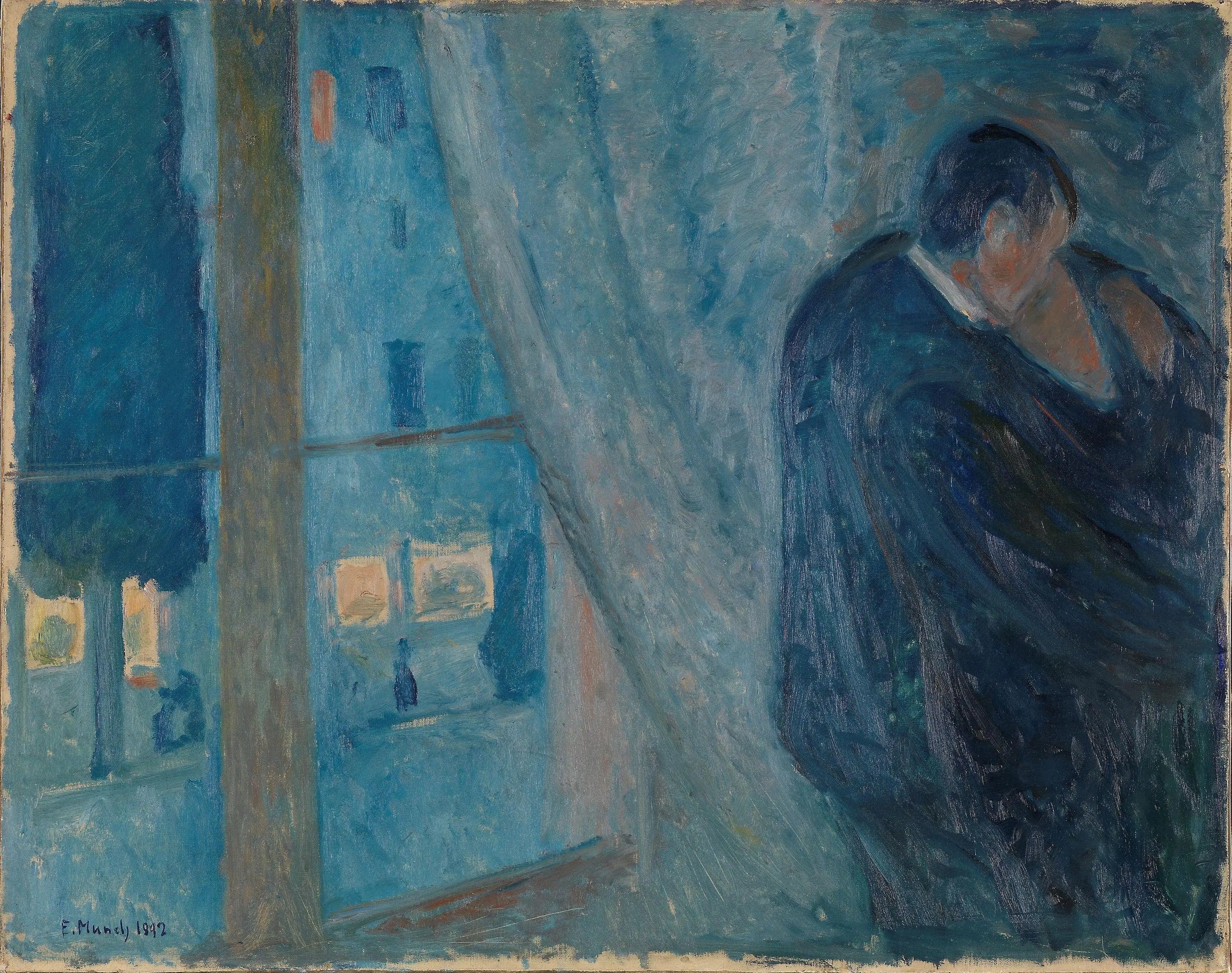
The Kiss by the Window
- Original dimensions
- 92 x 73 cm
- Museum
- National Gallery of Oslo
- Year
- 1892
Scene depicted
The Kiss near the Window depicts a poignant scene of a couple entwined, caught between intense passion and contemplation of the outside world. Munch skillfully plays with light to distill an atmosphere that is both intimate and universal, capturing the momentum of a kiss while surrounding it with an air of mystery and solitude. The lovers' gaze, lost in infinity, invites the viewer to share this moment of fragile tenderness.
Historical context
This painting is iconic and was created in 1892, in the beautiful city of Oslo, the capital of Norway. Edvard Munch , a leading figure of symbolism , captures a moment suspended in time, resonating with the melancholy of the late 19th century, a period rich in artistic and cultural transformations. Today, this canvas is housed in the National Gallery of Oslo, where it continues to move entire generations during its prestigious exhibitions.
Place in the artist's career
This canvas stands as one of Munch's major works, illustrating both the promising beginning of his career and his relentless quest to express existential angst. In parallel, his works “The Dance of Life” and “The Scream” show an evolution towards a more intense treatment of human emotions, making The Kiss near the Window a significant milestone in his artistic quest.
Anecdote
“Love is not just a tension, but a delicate guise in a dance of shadows.” This quote, imbued with mystery, evokes the genesis of this masterpiece , as Edvard Munch was inspired by a captivating spring morning, with light filtering through the veils of a window, drawing his gaze towards an emotion that is both troubling and beautiful. The strength of the canvas lies in this palpable tension between intimacy and the outside world.
Major exhibitions
Munch and France