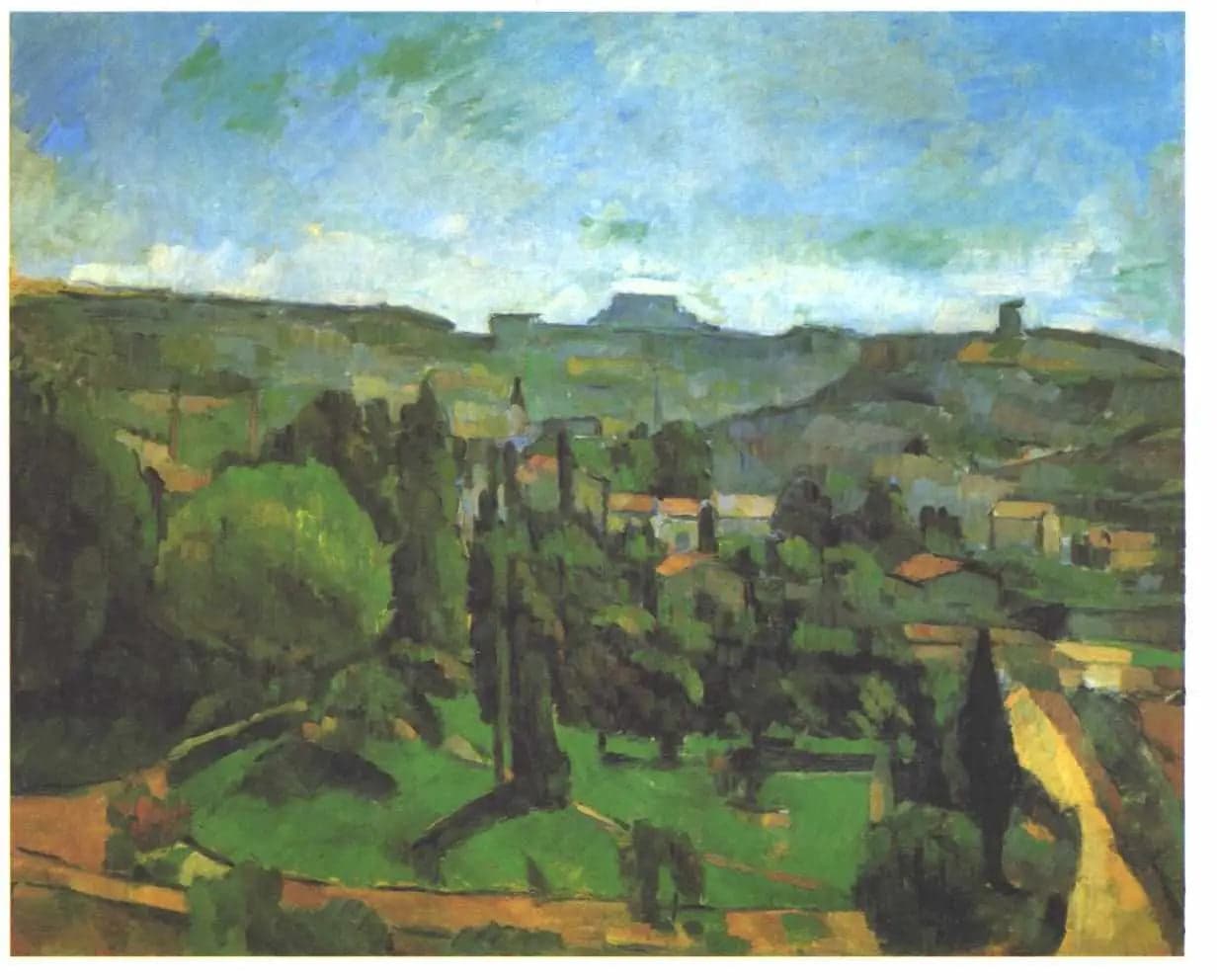
The King's Pestle, view from Bellevue
- Original dimensions
- 65 x 54.5 cm
- Museum
- Not specified
- Year
- 1879
Scene depicted
The King’s Pestle, view from Bellevue is a peaceful scene of the Provençal countryside, where the light of a setting sun mingles with the softness of the rolling landscapes. Cézanne captures here the harmony between geometric forms and the splendor of nature. The trees rise majestically, while a stone structure stands, symbolizing permanence in this changing world.
Historical context
Created in 1879 in Aix-en-Provence, this painting is part of the post-impressionist movement, reflecting Cézanne's artistic evolution. In a period where art frees itself from academic constraints, the canvas embodies a quest for form and color that characterizes its time. Although the current location of this pictorial work is unknown, the dimensions testify to a composition of beautiful magnitude, inviting contemplation.
Place in the artist's career
An integral part of Cézanne's stylistic maturation, this painting represents a turning point towards bolder and more structured compositions. In parallel to The Ascent of Mont Sainte-Victoire, and Still Life with Apples, The King’s Pestle embodies the transition towards a more subjective and personal representation of reality.
Anecdote
“Nature is my master, I am only its humble student.” These words of Cézanne resonate as an echo of the inspiration that guided the creation of this masterpiece . Imagine a spring morning, as a sweet scent of cherry blossoms floats in the air, the artist marvels at the picturesque landscape of Bellevue, thus forging the very essence of the canvas .