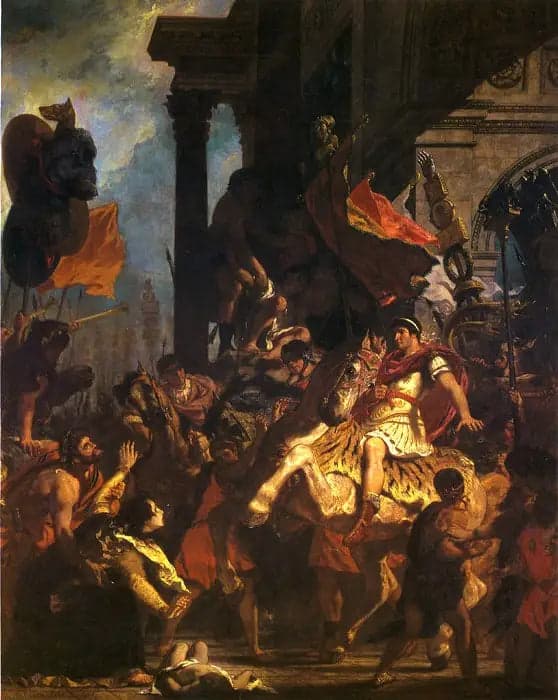
The Justice of Trajan
- Original dimensions
- 390 x 490 cm
- Museum
- Rouen Museum of Fine Arts
- Year
- 1840
Scene depicted
This iconic canvas captures a historical scene where Emperor Trajan dispenses justice for a young slave, thus evoking virtue and fairness. The characters, sculpted by light and shadow, seem to vibrate with intense emotions, while the dynamics of the composition direct the viewer's gaze towards this poignant moment. Delacroix succeeds in synthesizing drama and humanity, making this canvas deeply moving.
Historical context
Created in 1840, this painting is located in the historic city of Rouen, Normandy, during a time marked by romanticism . Delacroix's pictorial work resonates with the rise of ideals of freedom and justice. The canvas is now preserved at the Rouen Museum of Fine Arts , thus testifying to the importance of French art in the cultural landscape of the 19th century.
Place in the artist's career
By placing The Justice of Trajan at the heart of Eugène Delacroix's career, we discover a period of maturity where the artist consolidates his style. Alongside Liberty Leading the People and The Death of Sardanapalus , this painting reflects an evolution marked by emotional power and a bold exploration of historical themes.
Anecdote
“When the morning light illuminates the faces, the soul of each is imprinted in the painting ,” would have declared Eugène Delacroix one morning, as he sketched these majestic figures. This moment revealed the inspiration rooted in the contemplation of human passions, infusing an evocative power into The Justice of Trajan .
Major exhibitions
1855 World Exposition