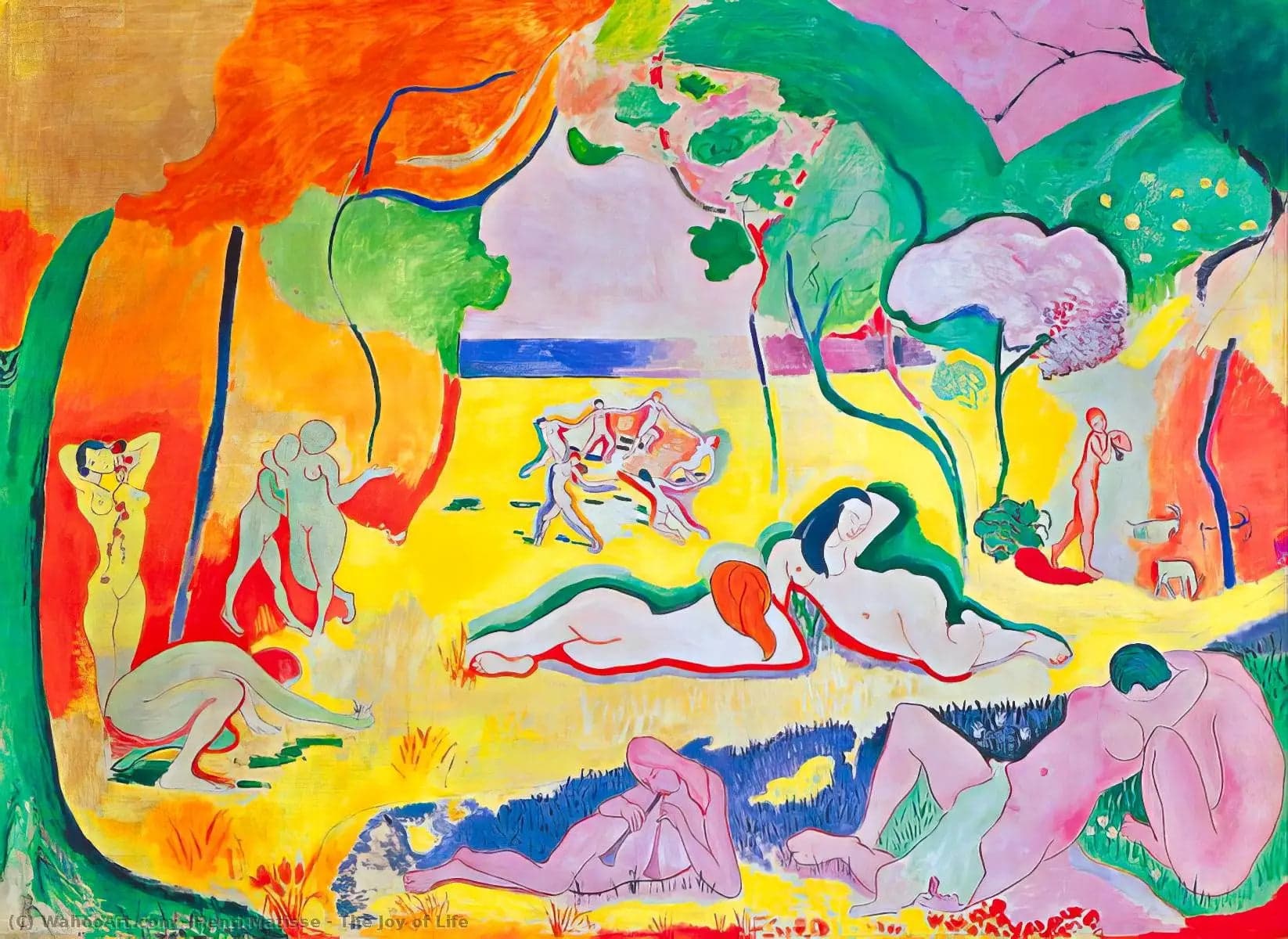
The Joy of Life
- Original dimensions
- 240.7 x 176.5 cm
- Movement
- Fauvism
- Museum
- Barnes Foundation
- Year
- 1906
Scene depicted
“The Joy of Life” unfolds before our eyes like a feast for the mind. On this painting , human figures frolic in a timeless landscape, merging bodies and nature in a frenzied dance. The bodies intertwine, blend, and color in a joyful surge, while evoking a serene apprehension of existence and love. It is not just a painting , it is a celebration of life itself.
Historical context
Created in 1906, during a prolific period of creation, the painting “The Joy of Life” results from a total immersion in Paris, one of the major artistic capitals of the time. Its belonging to the Fauvist movement marks the chromatic boldness and the exploration of new sensations. This masterpiece, currently housed at the Barnes Foundation , is among the paintings that defined an era that constantly redefined the codes of art.
Place in the artist's career
“The Joy of Life” represents a major turning point in the work of Henri Matisse , marking his ascent to the pinnacle of modern art. In contrast to his earlier works, such as “Woman with a Hat” and “The Happiness of Life”, this composition embodies a period where Matisse successfully married technique and emotion, sealing his fate as a master of Fauvism .
Anecdote
“Joy is in every stroke of color, where the heart expresses itself most sincerely.” This quote could very well have been spoken during a spring morning, as Henri Matisse strolled through a sunlit garden. It is precisely this joyful energy that pulses at the center of his canvas , revealing a collection of vibrant emotions and influences from everyday life.
Major exhibitions
Salon des indépendants de 1906