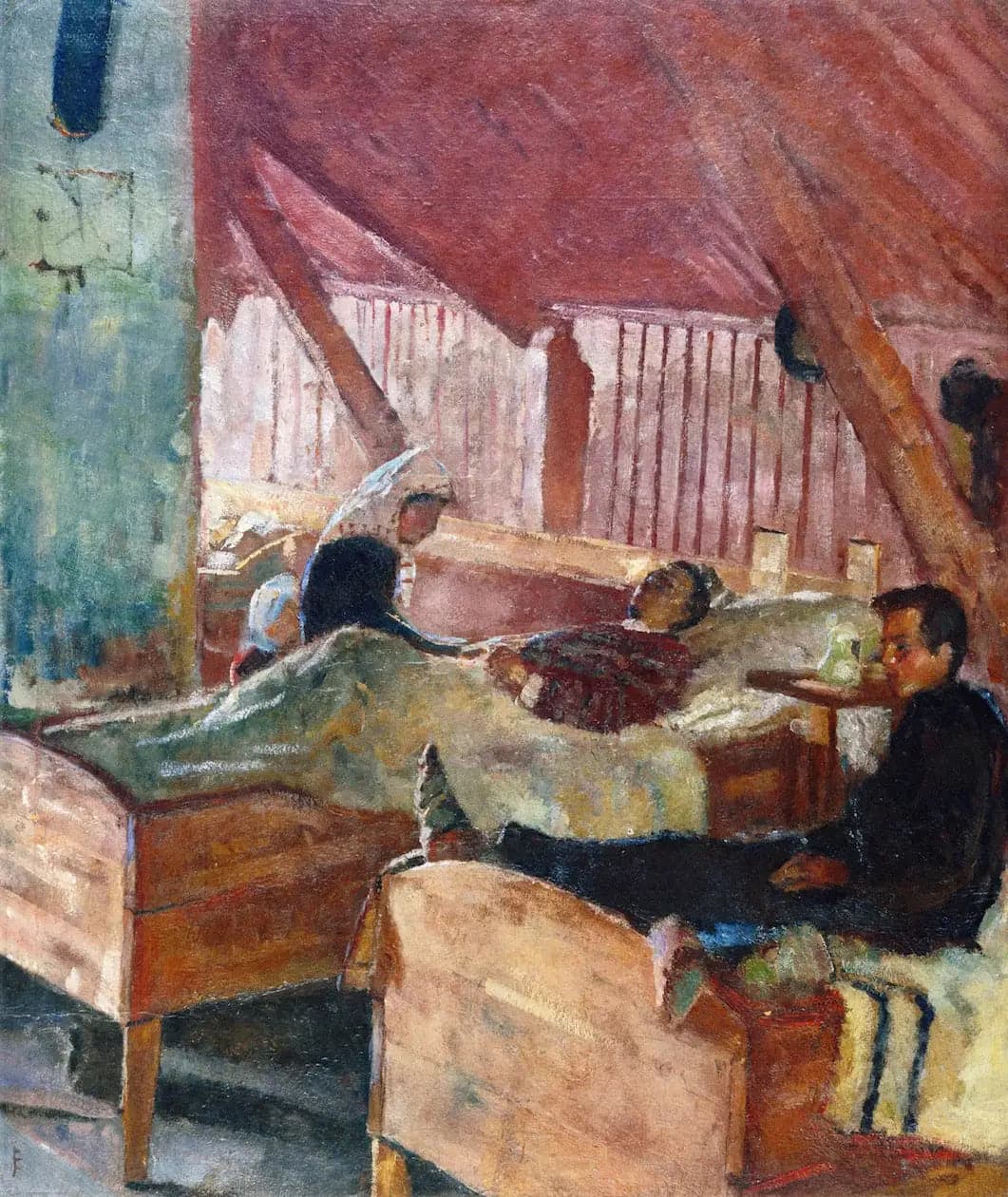
The Infirmary at Helgelandsmoen
- Original dimensions
- 58.5 x 67 cm
- Museum
- Munch Museum
- Year
- 1884
Scene depicted
The painting depicts an infirmary house, where tenderness and melancholy intertwine. The figures that inhabit it evoke stories of healing and solitude, while the captivating atmosphere of the place seizes the viewer. It is a true emotional journey, guiding the soul through the fragility of life.
Historical context
Created in 1884, this iconic work by Edvard Munch reflects a time when art took an emotional turn. Located in Helgelandsmoen, this painting illustrates not only events from a recent past but also deep feelings rooted in the human soul. Today, this exceptional painting is preserved in the Munch Museum, where it inspires visitors with its unique presence.
Place in the artist's career
The Infirmary at Helgelandsmoen is situated at the beginning of Edvard Munch 's career, witnessing his artistic evolution. This painting, alongside other masterpieces like The Dance of Life and The Scream, shows a stylistic turning point in his method: emotion takes precedence over reality. Munch boldly experiments with forms and colors that will soon give birth to his iconic style.
Anecdote
“A canvas is the shadow of our memory.” With each brushstroke, Munch recalled those long hours spent contemplating the pain and beauty of the places. In a quiet corner of Helgelandsmoen, he found this inspiration, one winter morning, when the light on the snow illuminated his inner universe. This essence is found in every fiber of The Infirmary at Helgelandsmoen.