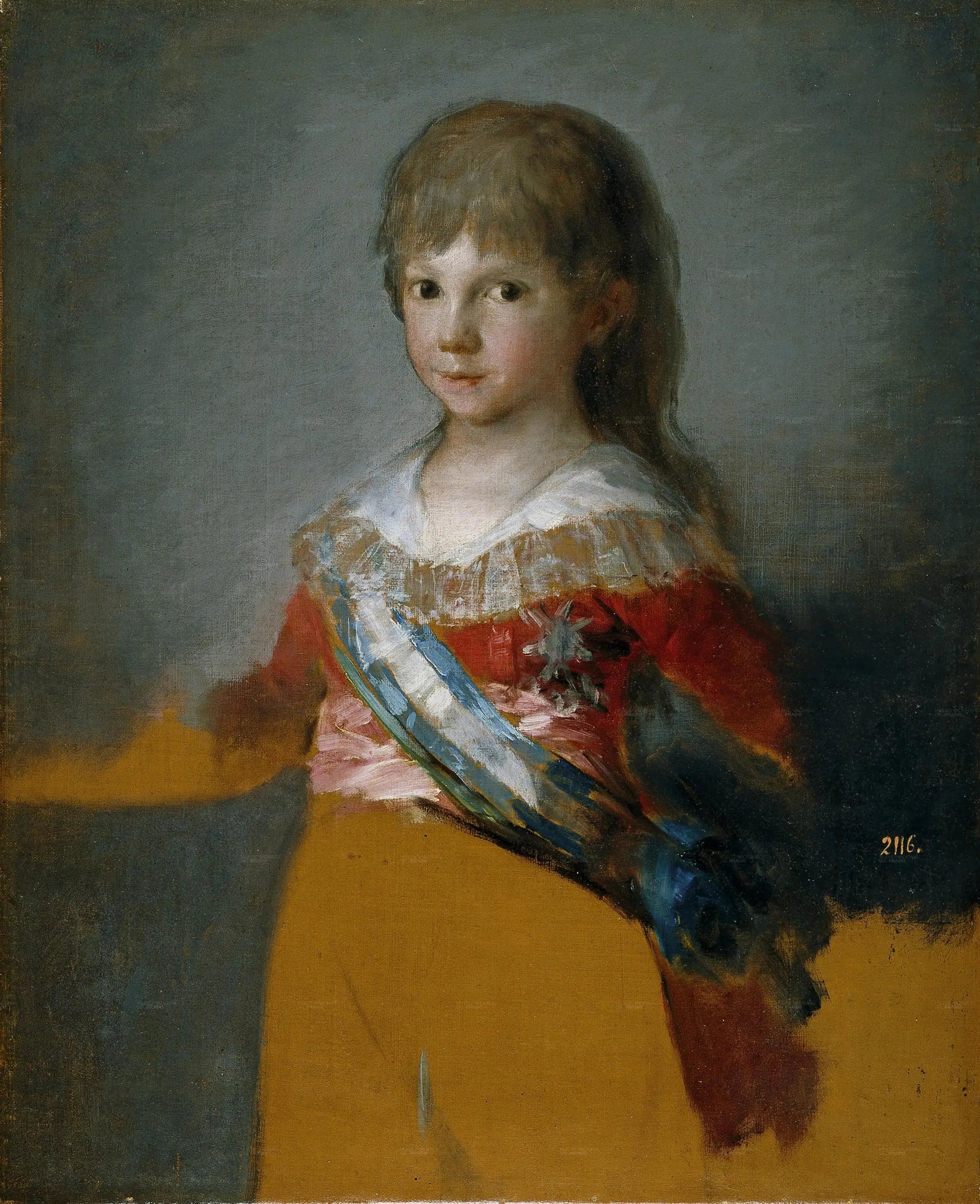
The Infant François de Paule
- Original dimensions
- 60 x 74 cm
- Museum
- royal palace of Madrid
- Year
- 1800
Scene depicted
The painting "L'Infant François de Paule" represents a moment of peace and reflection, where the central character exudes an aura of wisdom. The pictorial work, imbued with great delicacy, narrates the story of François de Paule, known for his life of devotion and charity, thus standing as a symbol of hope and light in a troubled world.
Historical context
Created in 1800, this painting emblematic of Francisco de Goya is set in the rich cultural context of Spain, in Madrid. This canvas, belonging to the romantic period, bears witness to the artistic heritage and emotional power that characterize the work of its creator. Currently exhibited at the royal palace of Madrid, this painting is also distinguished by its dimensions that enhance its visual impact.
Place in the artist's career
This painting occupies a prominent place in Goya's career, marking a period of artistic maturity. Compared to his earlier works such as "La Maja Vestida" and "The Executions of May 3, 1808," this painting reveals an evolution in his technique and a refined emotional depth.
Anecdote
It is said that Goya found inspiration for this masterpiece on a sunny morning, where the light filtered through the trees, illuminating the serene face of the Infant. "The eyes are the reflection of the soul," he would have murmured, thus capturing the very essence of the canvas through his brush. This quote evokes a deeply personal creative origin, connecting the artist to his subject.