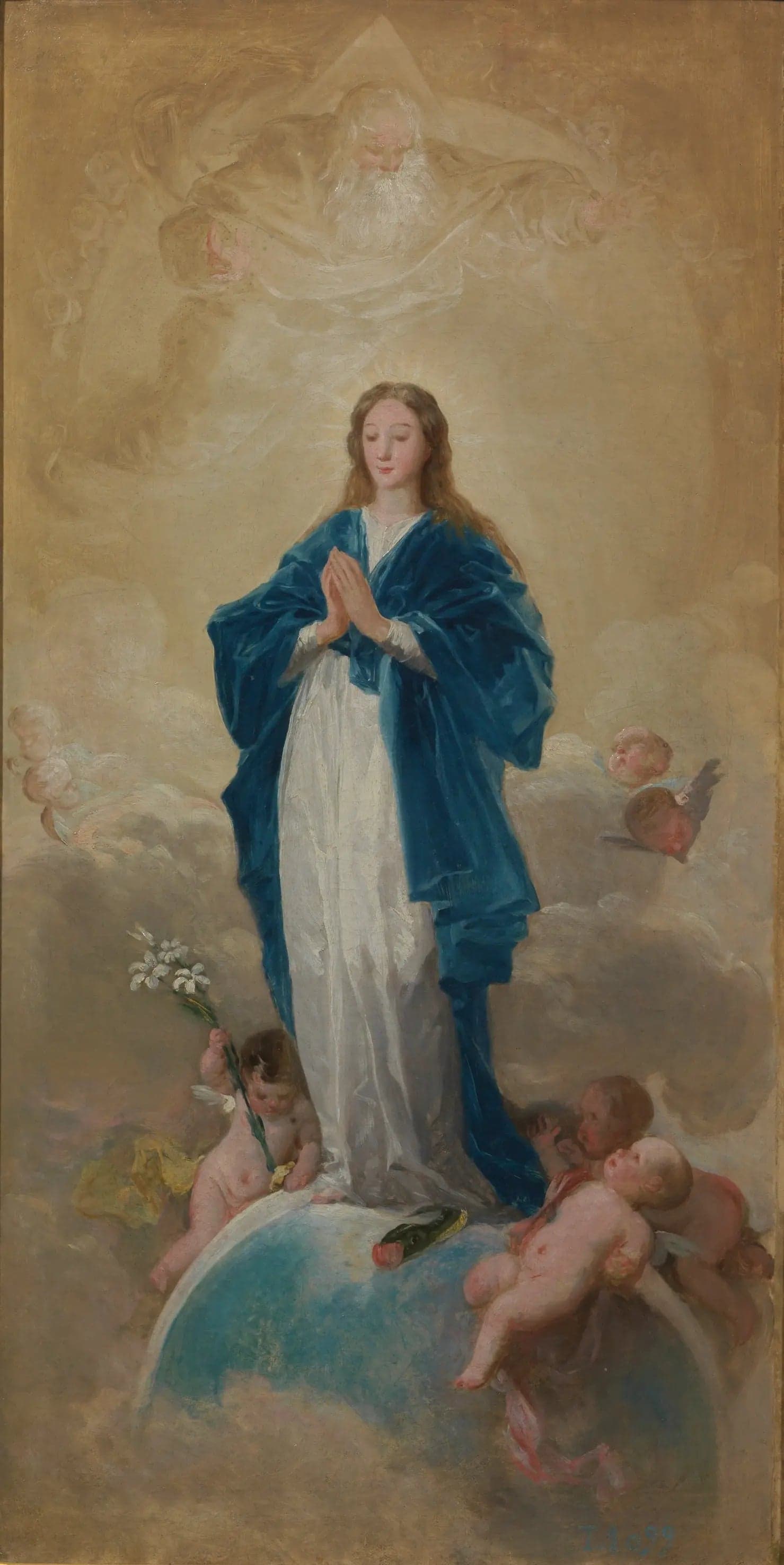
The Immaculate Conception
- Original dimensions
- 41 x 80 cm
- Museum
- Prado Museum
- Year
- 1783
Scene depicted
This pictorial work depicts the Virgin Mary, surrounded by graces and divine light, illustrating her state of Immaculate Conception. The painting transports us to the heart of a sacred vision, where the clouds seem to dance around the central figure, suggesting a connection between heaven and earth. Every detail, from the flowing garments to the angelic faces, emphasizes the purity and serenity of this transcendental moment.
Historical context
Created in 1783 in the heart of Madrid, this canvas is situated at the crossroads of a century marked by artistic and political revolutions. Goya's emblematic work, having found refuge in the Prado Museum, is part of the romantic movement. This painting, rich in meaning and light, evokes a time when spirituality and art intertwine.
Place in the artist's career
The Immaculate Conception marks a turning point in Goya's career, illustrating his transition to a more expressive and symbolic style. Alongside paintings like “The Naked Maja” and “The Executions of May,” one perceives an evolution towards emotional depth and mastery of shadows. This masterpiece reveals the nuances of his talent in juggling the sacred and the profane.
Anecdote
Francisco de Goya once declared: “Light is the soul of color.” Imagine him, lounging on a bright spring morning in his studio, inspired by the soft light filtering through the window, enveloping the forms in softness and mystery. This moment captured in the painting resonates in the depth of The Immaculate Conception and testifies to the artist's primal emotion.