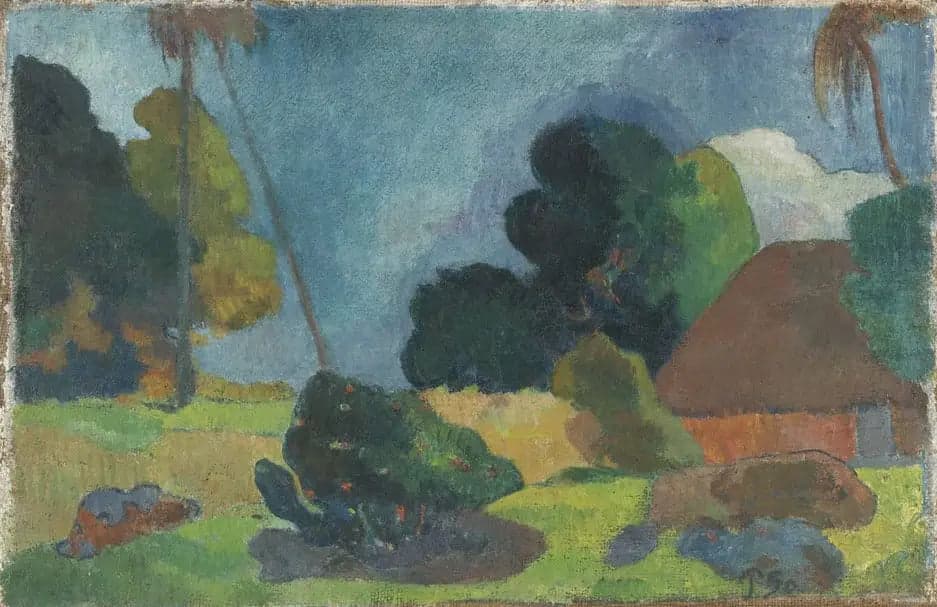
The Hut under the Palms
- Original dimensions
- 46.4 x 30.8 cm
- Museum
- Museum of Modern Art
- Year
- 1899
Scene depicted
The canvas , with its balanced composition, depicts a traditional Tahitian hut, surrounded by majestic palms. Gauguin captured the essence of island life, where the tranquility and spirituality of a simple existence blend with the wild beauty of the landscape. The vibrant colors convey an almost dreamlike atmosphere, a refuge away from the tumult of the modern world.
Historical context
Created in 1899, this iconic work is the result of Gauguin's stay in Tahiti. In a context of spiritual and artistic quest, it is part of the post-impressionist movements. Today, the painting is located at the Museum of Modern Art in New York, where it recalls the fusion between Polynesian culture and Western perspective. With dimensions of 46.4 x 30.8 cm, this canvas bears witness to a time when art was in constant search of authenticity.
Place in the artist's career
The Hut under the Palms is a milestone in Gauguin's career, marking a turning point in his technique. After his early works influenced by impressionism , he turned towards more introspective creations. In parallel, one can mention The Yellow Christ and The Vision after the Sermon , where the artist further explores symbolism and color, thus enriching his own pictorial language.
Anecdote
“Nature is my muse; it has inspired me with colors, shapes, sensations.” A phrase that resonates like a sweet melody. That morning, in the heart of the island, Gauguin encountered the soft light filtering through the palms. Inspiration surged: the vision of this hut, a tranquil refuge. This fleeting moment is captured in the painting , making The Hut under the Palms an echo of the living.