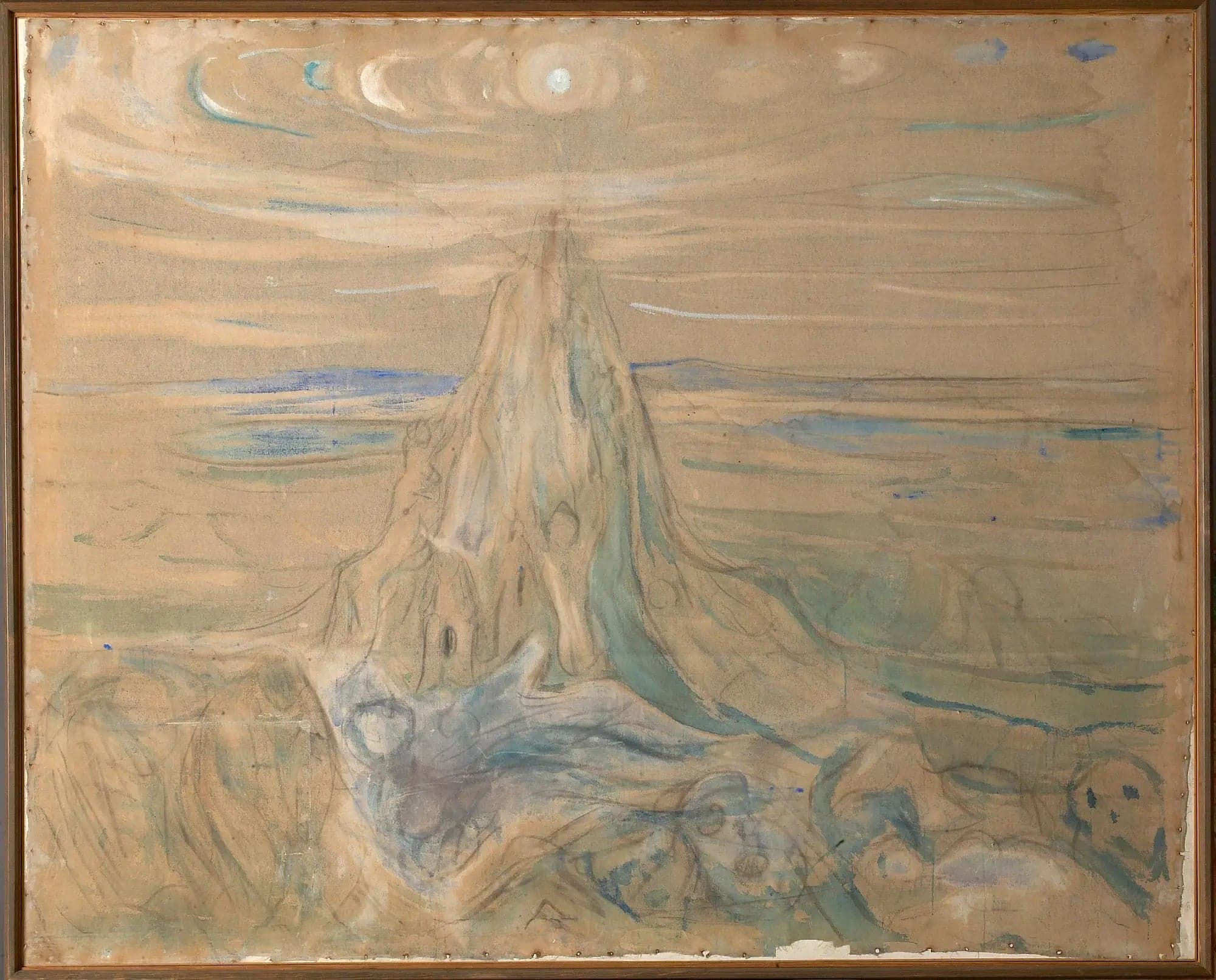
The Human Mountain
- Original dimensions
- 245 x 141.5 cm
- Museum
- Munch Museum
- Year
- 1909
Scene depicted
This canvas captivates by illustrating humanity confronted with the majesty of the mountains. The human figures, often depicted in poignant isolation, seem almost engulfed by the imposing nature. Their silhouettes, both insignificant and grandiose, question our place in the natural world. A moment of introspection, where the struggle between familiarity and strangeness unfolds with intensity.
Historical context
Created in 1909, in the vibrant setting of the city of Oslo, this painting is at the heart of the expressionist movement. At that time, art evolved, freeing emotions beyond conventions. The canvas, now displayed at the Munch Museum, embodies an era where the human soul is tested, oscillating between passion, suffering, and beauty.
Place in the artist's career
“The Human Mountain” represents a pivotal moment in the career of Edvard Munch . After works like “The Scream” and “The Madonna,” this painting reflects a stylistic maturation. The artist further explores existential angst in the face of sublime beauty. This painting cannot be reduced to a simple canvas ; it crystallizes an uninterrupted dialogue between the individual and nature.
Anecdote
“I paint what I have lived, what I hear, and what I feel.” One spring morning, as Edvard walked among the hills, the light fell on the peaks. An image came to him: human silhouettes, imbued with quest and aspiration. This vision becomes the beating heart of The Human Mountain , a composition where each brushstroke is an invitation to explore the depths of the soul.