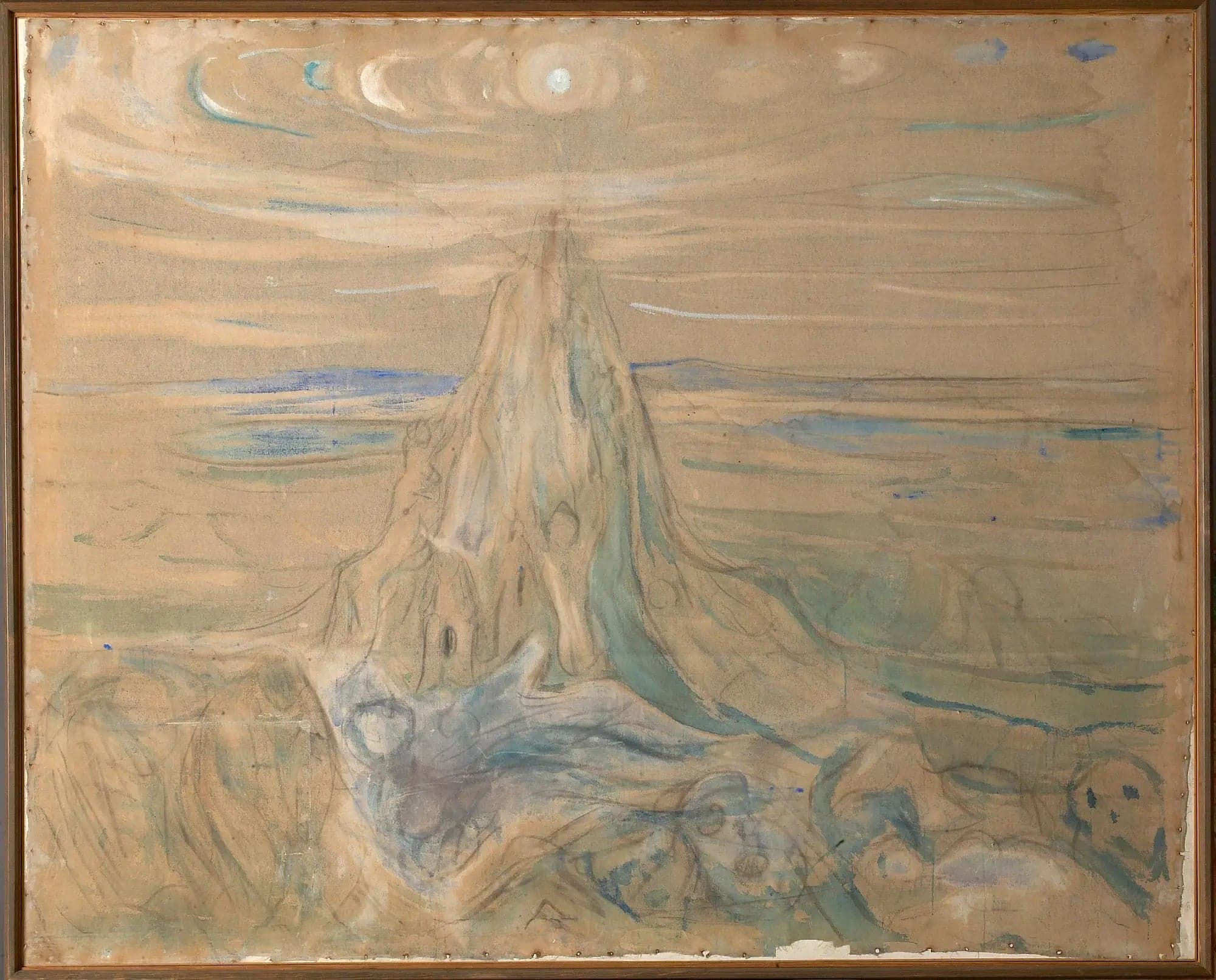
The Human Mountain
- Original dimensions
- 120.5 x 68.5 cm
- Museum
- Munch Museum
- Year
- 1909
Scene depicted
This painting depicts a majestic mountain, portraying a landscape of Norway where humanity is at the mercy of nature. The vibrant contrast between the dark and bright hues of the canvas enhances the emotional intensity, suggesting a perilous, sometimes heartbreaking, connection between man and his environment.
Historical context
Created in 1909 in Oslo, in a context marked by the rise of symbolism and expressionism , The Human Mountain reveals the inner turmoil of the artist, a reflection of a time in full transformation. Currently exhibited at the Munch Museum, this canvas is emblematic, measuring 120.5 x 68.5 cm, embodying the dialogue between man and nature, an often tumultuous interaction.
Place in the artist's career
The Human Mountain can be seen as a work of maturity in Munch's career, symbolizing his unique and avant-garde approach. It fits into a period where he began to merge his emotions with landscapes, akin to The Scream and Madonna , highlighting his evolution as a master of symbol and color.
Anecdote
“Nature has never distanced itself from me, and my emotions have always mingled with it.” This quote resonates strongly, evoking the spring when Munch roamed the Norwegian hills, a moment of serenity in contrast to his anxieties. This painting is the vibrant testimony of this inner quest, transcribed by his expert hand.
Major exhibitions
Edvard Munch . Monumental projects