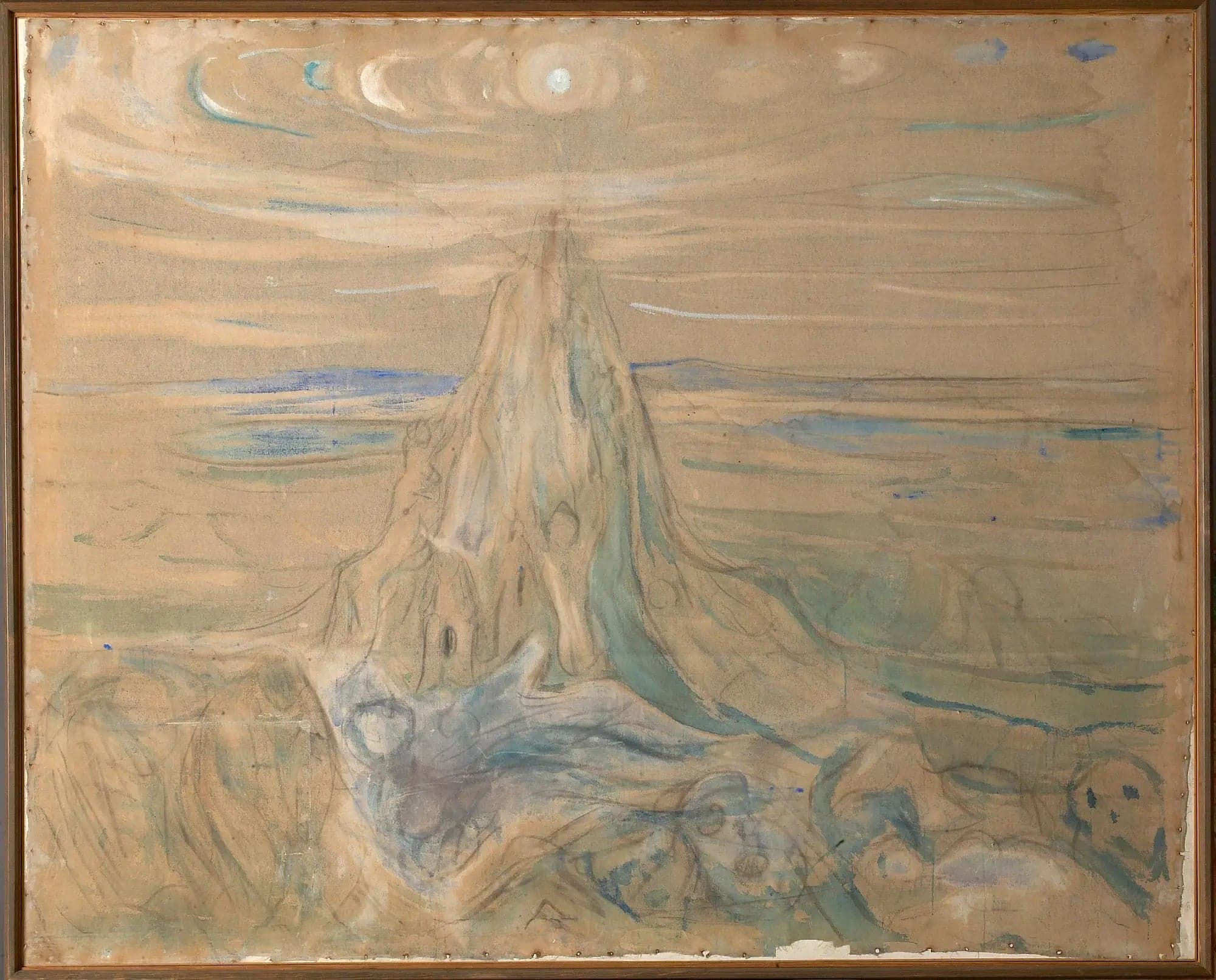
The Human Mountain
- Original dimensions
- 160.5 x 129.5 cm
- Museum
- Munch Museum
- Year
- 1909
Scene depicted
The Human Mountain is a composition that evokes a group of silhouettes walking on a steep path, symbolizing the human struggle against the challenges of existence. In this pictorial work, the anonymous figures are immersed in a life-sized landscape, where each element, from the diffuse light to the enveloping shadows, enriches the narrative, making palpable the tension between the individual and their environment.
Historical context
Created in 1909, this painting emblematic of Edvard Munch emerges in an artistic context marked by the exploration of human emotions and the deep symbolism of the expressionist movement. Displayed at the Munch Museum located in Oslo, this work testifies to Munch's creative genius, capturing a unique vision of the world. With its impressive dimensions of 160.5 x 129.5 cm, the canvas naturally finds its place in the history of modern art.
Place in the artist's career
This canvas is part of Munch's mature period, marked by unparalleled emotional intensity. Following The Human Mountain , one can observe an evolution towards works like The Scream , where anguish and solitude are expressed with striking power, or The Madonna , which addresses passion with delicacy. These paintings trace a fascinating path illustrating the artist's growing mastery.
Anecdote
“The world and our existence are a mountain to climb.” These words resonate with the essence of this masterpiece . Munch was inspired by a hike in the heart of the Norwegian fjords, where the majestic nature vibrated within him, transforming a simple scene into a painting full of emotional suspense and depth. The canvas thus becomes a reflection of this communion between man and nature.