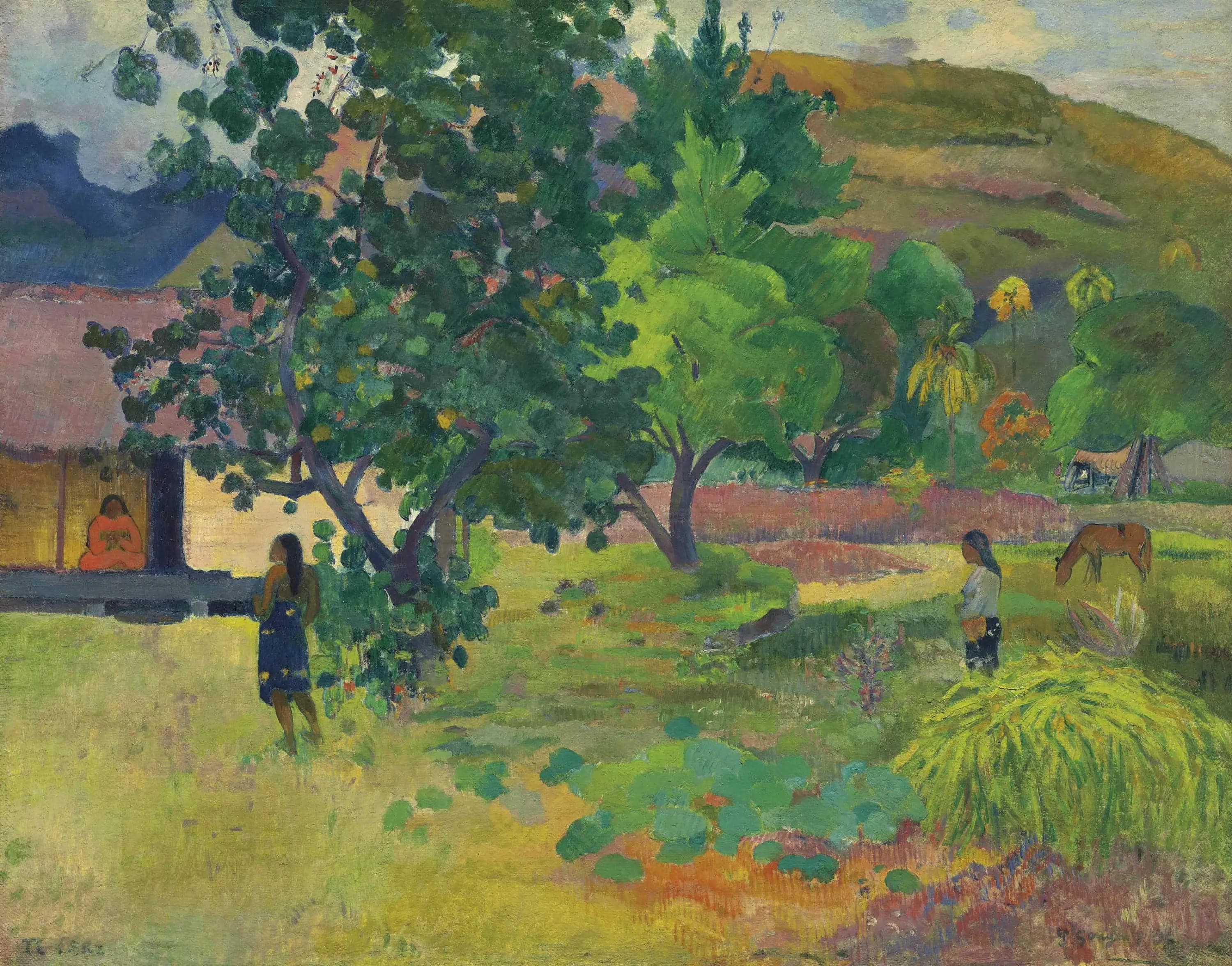
The House
- Original dimensions
- 91.8 x 72.6 cm
- Museum
- Not specified
- Year
- 1892
Scene depicted
This painting , depicting a typical house with soft and enveloping lines, evokes a world of tranquility. A narrow street, lined with greenery, invites us to imagine the stories unfolding behind its walls. The viewer's gaze is naturally drawn to the light flooding the scene, creating a warm and peaceful atmosphere. Through this painting , Gauguin succeeds in capturing the intimacy of a home, while hinting at the beauty of the surrounding nature.
Historical context
Created in 1892, this painting emblematic of Paul Gauguin finds its roots in the post-impressionist movement, a current that revolutionized the way light and color are perceived. Set in a vibrant artistic context, The House reflects a time when there was a quest to express subjectivity and light, even as the artist moved away from the primacy of photographic reality. The canvas is currently held in private collections, making this work a treasure difficult to access for art lovers, but of rare intensity due to its imposing dimensions.
Place in the artist's career
The House represents a turning point in Gauguin's career, marking the peak of his quest for a more free and personal artistic expression. After works such as The Vision After the Sermon and The Yellow Christ, this canvas bears witness to an acquired maturity, where the artist begins to assert his unique style. Each painting from this period reflects his constant search for harmony between form and color.
Anecdote
“Every brushstroke is a silent melody, a colorful dance of shadows.” It was in a small haven of peace, one spring morning, that Gauguin found inspiration for this masterpiece . The rays of sunlight filtering through the leaves of a nearby tree illuminated his painting , capturing the very essence of the nature surrounding him. Thus, The House becomes more than just a canvas ; it is an ode to the fleeting beauty of everyday life.